Thursday, 26 November 2020

How to Create a Change Champion Network


The podcast episode of this post is available on Sounder, Apple Podcasts, Google Podcasts, Stitcher and Spotify.

When you are short of time, here is the one action that will give you 80 percent results in 20 percent of the time.


DO THIS

Make membership desirable to trusted and respected peers.


BY DOING THIS

–        Ask leaders to appoint trusted and respected representatives.

–        Position the network as a leadership group.

–        Reward participation by including it in personal annual objectives.


Change champions (or agents) are respected and trusted people whose views and actions influence their peers. They help shape how people see the company.

A Change champion network organizes these highly regarded individuals into a team to support the change through spreading information, articulating benefits, role modeling new ways of thinking and providing feedback on how people are feeling. Through regular briefings, they act as your arms and legs throughout the organization as you implement a change plan.

To attract the best, you need to make the network a group that people want to be part of. Ideally, you will have leaders nominate members, so they buy into the network and support the time required to participate. Profiling this group to all employees and acknowledging their efforts by including membership in personal annual goals motivates members to fulfill their role with enthusiasm.


KNOWLEDGE BITES


CHANGE CHAMPION NETWORK PLANNER: Who needs to be a member of my change champion network?


SUCCESS TIP

Ensure all groups affected by the change are represented to maximize influence and avoid a slight that could cause resistance.


Tuesday, 24 November 2020

How to Create a Change Plan


The podcast episode of this post is available on Sounder, Apple Podcasts, Google Podcasts, Stitcher and Spotify.

When you are short of time, here is the one action that will give you 80 percent results in 20 percent of the time.


DO THIS

Describe how people will get prepared for the change.


BY DOING THIS

–        Concisely summarize what’s going on.
–        State your views on the best path forward.
–        Suggest the next step or two to put that path into action.

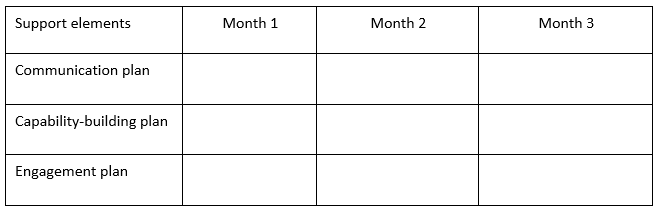
A good change plan describes how people will be able to adopt the change. There are three sections of an effective change plan: communication, training and engagement.

Communication describes how people will get information, e.g., through emails, town hall meetings, newsletters, etc. Training captures skill-building activities, including learning sessions, coaching and process walkthroughs. Engagement includes feedback opportunities such as plan review meetings, interviews and surveys.

Resist the temptation to make your plan long and complex. Many people believe a big plan is better, but the longer and more complex it is, the harder it is to communicate and implement. The best plans are easy to understand and follow. The worst response to a plan is, "I don't get it.


KNOWLEDGE BITES


CHANGE PLAN: How will I prepare people to do things differently?


SUCCESS TIP

Showing how the three people-support elements align leading up to the launch date will help leaders and their teams feel confident that they’ll be ready for the change.

Friday, 30 October 2020

How to Remain Calm Under Pressure


The podcast episode of this post is available on Sounder, Apple Podcasts, Google Podcasts, Stitcher and Spotify.

When you are short of time, here is the one action that will give you 80 percent results in 20 percent of the time.


DO THIS

Take control of the action.


BY DOING THIS

–         Concisely summarize what’s going on.

 –        State your views on the best path forward.

–         Suggest the next step or two to put that path into action.


Change projects are natural pressure cookers. Multiple teams, working on different activities with different timelines, often conflict over resources. Misunderstandings and frustrations happen. Anticipating these moments of tension is half the challenge of remaining calm through them.

The secret to keeping your cool is to control the action. It gives you strength and influence and puts you ahead of the crowd.

First, replay the facts of the situation—this will stop you (and others) from being drawn into the emotional drama of the moment. Next, recommend a solution. If others agree, suggest the next step to put the solution into action. If they don’t take your recommendation, facilitate a discussion around other options, summarizing where people are aligned and what they need to resolve.   


KNOWLEDGE BITES


ROLE MODEL PROFILE: How will I physically convey calmness when under pressure?

Think of a leader on the project who demonstrates calm under pressure. (Take 30 seconds)

How do they look (posture, gestures, etc.)?

____________________________________________________________________________

What are they saying?

____________________________________________________________________________

What are their eyes focused on?

____________________________________________________________________________

SUCCESS TIP

Emulating a successful leader subconsciously gives you the strengths you associate with them. 

Thursday, 29 October 2020

How to Empathize with Those Who Are Changing


The podcast episode of this post is available on Sounder, Apple Podcasts, Google Podcasts, Stitcher and Spotify.

When you are short of time, here is the one action that will give you 80 percent results in 20 percent of the time.


DO THIS

Understand their fears.


BY DOING THIS

–         Meet people in their workplaces (in-person or virtually).

 –        Ask them what they think about the change.

–         Restate their concerns and fears to demonstrate that you’ve heard them.


Managing change is about enabling people to do things differently with the least amount of disruption. Leaving tried and true routines can be more difficult than taking on new ones. Current ways are predictable, comfortable, easy and often linked to past successes. The more threatening the new ways appear, the more people will resist giving up the old ones. 

Change management often fails when there’s little understanding of, or empathy for, the people who are changing. Without deep knowledge of the environments in which they work, “ivory tower” assumptions guide change planning and lead to generic and ineffective support programs.

Spending time with people where they work will give you a good sense of their needs. They know their challenges better than you do, and they know what help they need to overcome them. Ask people about their concerns and listen to how they phrase them. This gives you insight into how to support them best as they adopt the change and reduce their resistance to it.


KNOWLEDGE BITES


AUDIENCE PROFILE TOOL: What are my audience's communication preferences?


SUCCESS TIP

Check that people have accurate information about the change before you ask them about their perspectives. Some don’t.


Wednesday, 28 October 2020

How to Manage the Unknown


The podcast episode of this post is available on Sounder, Apple Podcasts, Google Podcasts, Stitcher and Spotify.

When you are short of time, here is the one action that will give you 80 percent results in 20 percent of the time.

 DO THIS

Identify the information needed to understand the situation.


BY DOING THIS

–         List the information you already know.

 –        List the information you need to know.

–         Identify sources of expertise (internal and external) for what you need to know.


People struggle with unknown situations. These events are challenging because we can’t rely on our experience to guide our thoughts, actions or behaviors; we don’t know what to do.

The best approach is to make the unknown known by taking stock of what you know and don’t know. Creating lists for each forms a clearer picture that often looks like something you’ve seen in the past.

Start by listing what you know and what you need to know to understand the situation. Next, identify sources for the information you need to find out, including internal and external resources. Often, people in your circle have experienced similar challenges, and will have views on details and potential solutions. You now have the beginnings of an action plan to follow.


KNOWLEDGE BITES


AUDIENCE PROFILE TOOL: What are my audience's communication preferences?


SUCCESS TIP

Sharing a draft plan is the quickest way to identify more information sources—including those whom you share it with.


Thursday, 24 September 2020

How to Communicate Effectively


The podcast episode of this post is available at Apple Podcasts and Google Podcasts and Spotify.


DO THIS

Always be the best source of information.

BY DOING THIS

–         Communicate early and often.

 –        Speak from the audience’s perspective.

–         Share everything you can, honestly (don’t spin).


Communication is the most important form of support people receive when going through a work transition. It’s also one of the biggest enablers of successful change because it aligns everyone on their understanding of what’s changing, why it’s necessary, how it will affect them and what they must do to adopt it. 

Setting up a frequent and consistent communication schedule creates the expectation that people will receive regular updates from leaders and the project team. Communicating honestly in ways that your audience can relate to creates the perception that these messages are the best sources of information. You must regularly communicate even when there is nothing new to share. If you don’t, rumors and speculation fill the void, and such counter-narratives will seem credible, distract people and increase anxiety.


KNOWLEDGE BITES


AUDIENCE PROFILE TOOL: What are my audience's communication preferences?


SUCCESS TIP

Test your messages with a few members of your audience to avoid (or at least be prepared for) adverse reactions.


How to Not Take Things Personally


The podcast episode of this post is available on Apple Podcasts and Google Podcasts and Spotify.


DO THIS

Step back and look at the big picture.


BY DOING THIS

–         Put yourself in other people’s shoes.

–         Consider why the person acted the way they did.

–         Meet with them to get their perspective.


After a tense and explosive meeting, I asked a leader how she felt. “Fine; it’s not personal,” she said. By separating content from emotions, this leader didn’t respond emotionally to the theatrics of others and remained focused on the facts, objectives and decisions required.

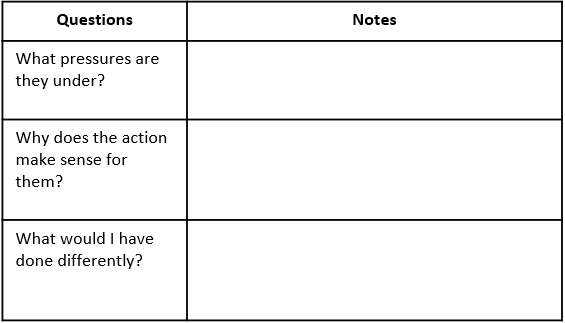
Putting yourself in the other person’s shoes helps neutralize the incident. What’s going on in their heads? What pressures are they under? Mood, limited information and past experiences could be triggering their behaviour.

Checking in with the person after an incident to ask why they behaved the way they did will discourage future outbursts, show your maturity and improve your relationship.
To avoid emotional responses and regrettable behaviour, hold back from impulsively reacting to a tense situation. With practice, this will become habit.


KNOWLEDGE BITES


SITUATIONAL ANALYSIS TOOL: How will I keep things in perspective?


SUCCESS TIP

Asking the person why they did what they did in a non-judgmental way will avoid making incorrect assumptions about motives.


Wednesday, 9 September 2020

How to Set Your Personal Goals


 The podcast episode of this post is available at Apple Podcasts and Google Podcasts and Spotify.


So, what is the one thing I recommend you do to set your personal goals for a change initiative when you are short of time?


DO THIS

Pick three goals: one skill goal, one behaviour goal and one relationship goal.


BY DOING THIS

  • Select your three goals.
  • Define what success looks like for each one.
  • Track your progress.


An institutional change project provides real opportunities for personal growth because it’s dynamic, complex and involves people at all levels and areas of an organization. Without personal goals, you’re more likely to focus on completing tasks with little thought to increasing your abilities.

One of the first things you should do after joining a project is to decide how you want the experience to benefit you: how will you grow? The three areas of development I have listed are the ones that will give you the highest return: skills (what you do well), behaviours (how you act toward others) and relationships (a connection you share with someone). Knowledge (what you know) is the fourth, but I recommend you focus on the first three for now.

Skills, behaviours and the ability to connect with others are types of leadership capability. Telling the story about how you achieved all three is part of your career leadership narrative. To create that narrative, write down a goal for each category and what success looks like for each. Then track your progress over the project. Your notes will give you the depth you need to make your story detailed, fact-based and compelling.


KNOWLEDGE BITES


GOAL TRACKER TOOL: What are my personal goals for this change initiative?


SUCCESS TIP

Post your goals where they’re visible (e.g., screen, calendar, journal) so they stay top-of-mind.


Monday, 7 September 2020

How would you describe your personal brand story?

A former colleague, Alejandro Colindres, asked to interview me about my personal brand story for a book he is writing. Fortunately, I update my personal brand regularly because it doubles as my company’s value proposition—my company is an extension of me.

Alejandro said he would ask three questions. Here are my answers:

What would you say your professional brand is?


“I help leaders and their teams achieve their personal and business goals by providing change expertise and skill building.”

Alejandro’s personal brand definition includes three elements: experience, strengths and values.

Experience: change expertise from leading and managing 32 large change initiatives over 30 years across 60 countries.

Strengths: Providing advice and building skills are the core strengths that I deliver through writing, training, coaching, and mentoring.

Values: One of my values is “to serve.” It is referenced through the word “help” and the inclusion of both personal and business goals. Often my work expands beyond the scope of my assignments to give individuals extra support so they can be their best during change.

Walk me through your journey of how you built your brand.


I built my brand through the roles I applied for and held. My first business role was helping small and medium-sized businesses build their skills and capabilities. Each subsequent position had learning or change elements to it, from process reengineering to culture development to mergers and acquisitions. Coaching and mentoring opportunities followed that allowed me to better individualized my support.

How has your brand evolved over time?


My brand is far more focused on outcomes now. Without clear and measurable goals, you can provide the support that might not be useful or of value to people. I learned to be laser-focused on objectives.
Over time, I have realized that everyone goes through a personal transition when their organization does. People must be whole and grounded before they can achieve their best. Change is always personal, and that is where my support begins.

Alejandro and I had a good conversation. What would you say if he asked you his three questions?