Showing posts with label #risks. Show all posts

Monday, 26 September 2022

How to Handle Mistakes


 This post's podcast episode is available at Sounder, Apple Podcasts, Google Podcasts, Stitcher and Spotify.

When you are short of time, here is the one action that will give you 80 percent results in 20 percent of the time.


DO THIS

Own the mistake and how to correct it.


BY DOING THIS

–  Take accountability quickly.

–  Share steps to correct it and the help you need.

–  Detail what you learned and will do differently.


Mistakes are inevitable when managing change. There are too many moving pieces on different schedules and run by different people to avoid missteps.

Given the stress (and fear) that major change initiatives inevitably produces, people can default to responses that deflect ownership, compromise resolution, and obscure learning when something goes wrong. This behaviour often adds risk to the project and damages relationships. A better and more difficult approach is to expect and address mistakes as they appear.

Taking accountability for a mistake, especially in public, will set you apart. People will remember how calmly you handled the situation and soon will forget about the mistake. 

First, take ownership of the mistake. Next, state what you are doing to correct it. Talking about the solution focuses people on the path to correction vs. the actual mistake. Close off your comments by sharing what you learned and what you will do differently in the future.


KNOWLEDGE BITES


MISTAKE CORRECTION PLANNING TOOL: What are the steps I need to take to correct the mistake?


SUCCESS TIP

Don’t explain in detail why you did what you did. It’ll sound like you’re making excuses and take focus away from how you are fixing the mistake.

For more stories, insights and advice, listen to the Handling Mistakes podcast episode with executive and change leader Michelle Yanahan.

Phil Buckley is the author of Change on the Run and  Change with Confidence, host of the  Change on the Run Podcast, and co-creator of the  Sharing Change with Confidence Newsletter.

#change #changemanagement #transformation #leadership #projectmanagement #mistakes #podcasts 

Saturday, 28 May 2022

How to Close a Change Project


This post's podcast episode is available at Sounder, Apple Podcasts, Google Podcasts, Stitcher and Spotify.

When you are short of time, here is the one action that will give you 80 percent results in 20 percent of the time.

DO THIS

Define the closing date as the first time you can accurately measure benefits.


BY DOING THIS

–        Start Gain agreement from leaders that the project closes after benefits are measured.

–       Set the closing date with leaders and add it to the project plan (and leaders' calendars).

–       Develop a work back plan to ensure sufficient transition and measurement activities are in place.


Managing the close of a change project is challenging because most leaders and project team members have mentally moved on to their next roles and challenges.

Defining the close date as the point in time when benefits are first measured reduces the risk of the final tasks being rushed or missed. It also broadens the project and operating teams' focus to include realizing the change benefits.

Adding the closing date to the project plan necessitates a work back schedule including benefit tracking and recording activities. This work may extend some project team members' participation and uncover additional insights and lessons to guide future transformations.


KNOWLEDGE BITES


BENEFITS MEASUREMENT TOOL: What benefits will be realized by the project close date?


SUCCESS TIP

Identifying the absence of benefit measurement as a risk in the planning phase increases the likelihood of leaders supporting an extended close date.

For more stories, insights and advice, listen to the Closing a Change Project  podcast episode with HR and change management expert Tim Creasey.

Phil Buckley is the author of Change on the Run and  Change with Confidence, host of the  Change on the Run Podcast, and co-creator of the  Sharing Change with Confidence Newsletter.

#change #changemanagement #transformation #leadership #projectmanagement #sustainment #podcasts 

Thursday, 16 December 2021

How to Create a Plan B

This post's podcast episode is available at Sounder, Apple Podcasts, Google Podcasts, Stitcher and Spotify.

When you are short of time, here is the one action that will give you 80 percent results in 20 percent of the time.


DO THIS

Define your next best option.


BY DOING THIS

–      Agree on what is the best response if Plan A doesn’t work.

–      Map the steps to take if a serious risk materializes.

–     Review Plan B with people who have a role to play.


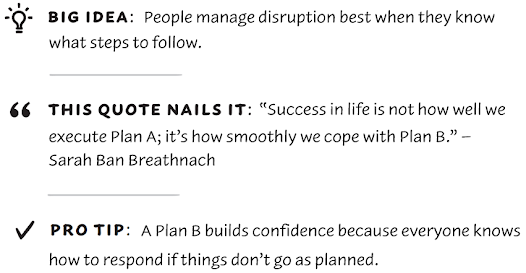
“Always have a backup plan (a ‘Plan B’),” is a good rule to follow for all important activities. Most plans don’t go as intended because there are too many variables to predict. Variances can cause delays, extra costs and compromised credibility.

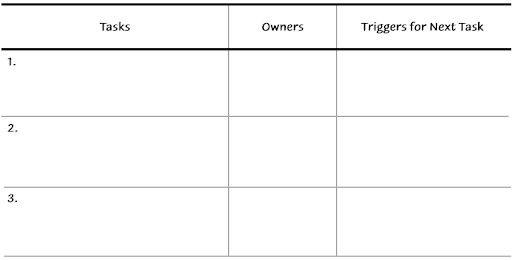
A good Plan B manages the impacts of things not going as intended. Thinking through what could go wrong and the best response to them will avoid major disruption from unanticipated events. Ask people who have roles in Plan A how they would operate if a specific risk materialized. The answers will identify the actions that form your Plan B. For each action, record when it happens and who is responsible. Review the steps with everyone so people will know what happens immediately before and after their actions.


KNOWLEDGE BITES


RESOURCE ASSESSMENT TOOL: How many resources do we need to complete the task or project?


SUCCESS TIP

Communicate what event will trigger the backup plan so everyone is clear on when it is in effect.


The Creating a Plan B podcast episode with business and market development expert David Smyth.

Phil Buckley is the author of Change on the Run and Change with Confidence, host of the Change on the Run podcast, and co-creator of the Sharing Change with Confidence Newsletter.

#change #changemanagement #business #transformation #leadership #contingencyplans #podcasts