Friday, 19 July 2013

Why say good-bye when you can say see you next time?

Journeys are a series of beginnings and endings. Each phase starts with exploration, followed by understanding and capability. Just when you are getting good at something it is time to move on to the next phase, and the cycle begins again.

This has been true for me with the creating and marketing of Change with Confidence. First it was the concept phase, then writing, editing, pitching, formatting and promoting. Each one followed this development cycle.

One of my favourite phases has been the promotion phase.  I hired Media Connect, a New York-based book promotion and author publicity firm to support my book in the U.S. A best-selling author had given me a great reference and my initial conversation was David, Managing Director, was excellent. Have you found that there are some people you meet and just know you will get along with famously? This is how I felt about David. 

Steve Matteo, David Hahn and Eric Glover
I felt like a sponge when I met David and his team members, Steve and Eric at their office. I kept saying, "And what else, is there anything else, from your experience, what else should we do." I also invited them to use me as a guinea pig if they wanted to try new things. 

I learned so much from my five-month campaign. Their expertise was evident from day one. They worked with Wiley to get promotional galley (first-print soft-bound copies  for journalists). They also quickly leveraged their network across print, radio, public speaking and internet media channels. I was in good hands from the start.

Here is what the team triggered for Change with Confidence:

- 6 Reviews                           
- 8 Articles/Guest Posts   
- 3 Interviews                      
- 1 Talk/Event            
- 1 Webinar                      

I am thrilled with the coverage! I won't attempt to pick my favourite experiences. Each one taught me something new, whether it was approach, format or customization to a particular audience. Each one built my promotion skills. 

Beyond PR, the team shared their knowledge of the publishing industry. For example, David said there are two types of authors: one that puts out a book every two years and the other who does so every five years. The first type tends to repeat themselves while the other writes something new and uniquely profound."

Why say good-bye when you can say see you next time? It will be a little while longer than I originally thought. Thanks guys!

Phil

Friday, 12 July 2013

Less is More When Speaking in London


I received great news last week. My proposal to speak at the Association of Change Management Professionals' Europe Conference was accepted!

This achievement is important in many ways. It's my first speaking engagement outside North America, which begins the global phase of marketing Change with Confidence. Also, it is a premiere conference with excellent speakers, run by a distinguished organization−it's a five star event. Another reason is that it is being held in London where I was based at Cadbury for three years. I will have the opportunity to visit old friends. It's going to be a great week.

The speaker review process was thorough and included a written proposal, a submission of additional information and a Skype-recorded presentation on my content, audience target and level of interaction.

I was intrigued by the focus on attendees' participation. Many years ago, I realized that when leading training sessions, the less I spoke  the more people learned. Their engagement and exploration of concepts is where most of the learning takes place.

The approach I am taking for my session is new to me. After sharing my key insights on change, I will "crowd source" the direction the conversation will take: the participants will determine what real-life scenario we will discuss, what questions we will answer and what approach we will take to do so? Self-directed learning to the power of 75-150 people.

My preparation will take longer than usual because I need to be ready for all combinations of options.  I will also need to design a way for people to interact with each other as they progress through the choices. 

This will be the most adventurous presentation I have given on change: spontaneous, dynamic and perhaps even chaotic. Like dealing with change, the destination is clear but how you really will get there is not. As long as I talk less than the participants, we will learn a lot.

Phil

Friday, 5 July 2013

What would it take for you to subscribe to a newsletter?

One of the simplest and most important design elements of my web site is the newsletter registration form.

Kro and Mel, the designers of my site, and I discussed how it should look and where it should be located to maximize subscriptions. Our goal was for everyone who advanced past the home page to have the opportunity to sign up. We agreed to put the form on every page that had space for it. 

I have always been a fan of newsletters. They provide relevant information in short, easy-to-read articles. The content is tailored to one of my interests and sourcing them myself would be difficult and time consuming. 

The Change with Confidence newsletter needs to offer these attributes to people delivering change. Our aspiration is to create a clipping service of change-related articles that have caught our eye. Each one will include an introduction explaining the reasons for selecting it and how it could be helpful to the reader. Given this context, readers will decide whether each article is worth reading (if any of them).

The format of the newsletter is important too. It needs to be a clean design that is easily scanable. It should take less than a minute to identify what is worthy of someone's time.

Digg and  Stumbleupon are inspirations for the look of the newsletter. They are simple, easy to read and visually appealing. 

Newsletter Format Prototype
Kro created a prototype that we are populating for the first issue. Each monthly newsletter will begin with a summary blurb of the articles we select followed by the articles and commentary. We will launch a six-article format because nine seemed too long and three seemed too short. Ultimately, the readers will decide what is the best length for the newsletter. 

The first issue will be distributed in less than two weeks. My hope is that readers will find the articles current, eclectic and thought provoking. Ultimately, they will decide what types of articles are best for them.

I am excited by the launch. Our newsletter provides one more way to help people deliver change. If interested, you can subscribe here.

Phil

Friday, 28 June 2013

The Only Entrance Requirement is Interest

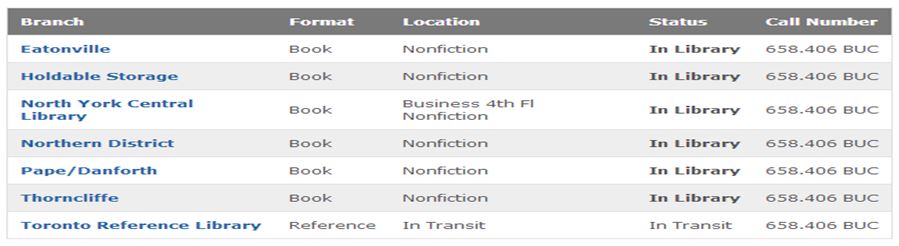
My sister-in-law, Ellen, sent me a text saying that Change with Confidence had been purchased by the Toronto Public Library system. Seven hard copies and one e-copy were catalogued in their on-line database, and the e-copy had already been reserved!

This is big news to me. A library bought my book. More people will now be reading it. I wrote a library book. Like other milestones, I thought, "This is a real book."

I am nostalgic about libraries. I remember as a boy signing-out books for school projects. As an adult, I searching through research manuals for publishers to pitch. I had a purpose and the library enabled me to accomplish it.

Toronto Reference Library
Home of Change with Confidence
Who will be using my book and how it will be used? Will people take notes, reference quotes, write in the margins or maybe even rip out pages instead of copying them (the horror)? Will someone owe fines for keeping my book past its due date? 

Mostly, I think about my book reaching a new audience. People with their own purposes using my book for free. Lady Bird Johnson said, "Perhaps no place in any community is so totally democratic as the town library. The only entrance requirement is interest."

Like most great opportunities, I am thinking about how to scale it. If one library system is interested in Change with Confidence, how do I engage others who may feel similarly. I have to believe there is lots of interest.

Phil

Thursday, 20 June 2013

One Thing Leads to Another, and Another...

On June 6th, I gave a webinar about the biggest questions of change. It was sponsored by Soundview, a company that provides professionals with business intelligence in time-efficient ways. It offers business book summaries, author webinars, and video interviews to build awareness and skills on the latest business thinking.

A webinar is an on line seminar where participants hear your voice and watch your slides on screen. They also have the ability to ask questions and leave comments. There are both benefits and challenges to this presentation format.

On the benefits side, you are presenting in a controlled environment with the freedom to review your notes and pace your talk. Also, it is easier to answer questions and discuss comments because the moderator frames and sequences them. Another benefit is that you are not distracted by the participants because their phones are muted and they are invisible, which is helpful, especially when the audience is in the hundreds, like this one.

On the challenges side, you are talking into a speaker phone for forty-five minutes non-stop. Your voice needs to modulate to make points and create excitement so that people stay engaged. 

My friend, Michael, who is an excellent speaker, suggested I adopt a conversational tone. He also suggested that I ask people to reflect on my points and invite them to consider their relevance based on what they were experiencing.  Both tips were helpful and made my talk sound more personal. It felt like a conversation every time I posed a question to participants.

It's always helpful to be a member of a great team. Ursula, the executive producer, and Andrew, the moderator, were incredibly helpful. They shared presentation tips and examples of other successful sessions. They were also very supportive and personable. By the time we went "live," I felt like I knew them personally although we had never met in person. 

The 3-2-1 countdown before starting a presentation is always a "time stands still" moment for me. This is when I straddle between  preparation and action just before I take my step into delivery. I started my talk with a story about my first change project and went on from there. My time flew by and forty-eight minutes later I asked Andrew if there were any questions.

The participant questions were ones that I had answered in Change with Confidence. It was good to see that people were interested in what I had dealt with. They included changing priorities during a change project, dealing with resistance, and avoiding slipping back into old ways of working. This part of the session was the most dynamic and enjoyable.

Attendees were invited to leave a comment on my website if they wanted a copy of my slides. Over seventy-five people left comments and received my Powerpoint slide deck. I thought about  sending a PDF file of my slides but my goal was to help people delivering change, not to protect my work. I hope they use my slides in their change presentations. 

A couple of weeks before my presentation, I got the great news that Soundview had awarded "30 Best Business Books of 2013" status to Change with Confidence. This means they will write an Executive Book Summary and record a twenty-minute audio version of it. They will also record an author interview that will be distributed to all members. I couldn't be more thrilled.

The Soundview experience has been tremendous. One thing did lead to another and another. It may even lead to another. That's how it works.

Phil

Friday, 14 June 2013

What Got You Here Won't Get You There

I am really enjoying presenting at conferences. Attendees are interested in my topics and are willing participants in dialogues. They also have a host of good and bad experiences around change that adds flavour and relevance to the sessions.


Marshall Goldsmith
Beyond the thrill of presenting, I have the opportunity to learn from other presenters. I was keen to see Marshall Goldsmith open the HRANS conference a week ago. He was voted the #1 leadership thinker and #7 business thinker in the world at the Thinkers 50 ceremony sponsored by the Harvard Business Review. He is also a million-selling author and editor of 31 books. His list of accomplishment is massive.

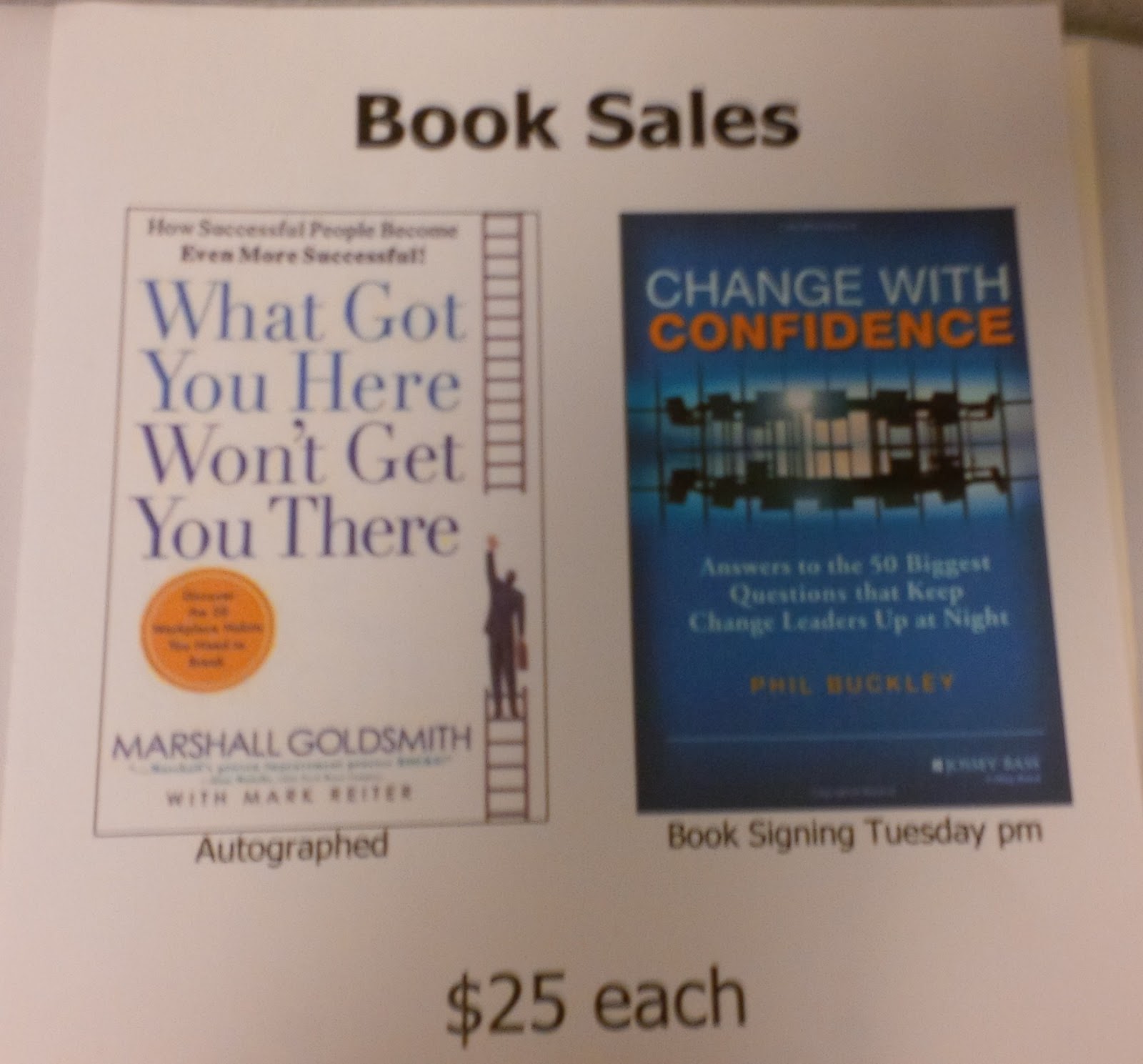
Marshall was sharing concepts from his latest book, What Got You Here Won't Get You There. I like the title, which reminds me of the saying, "If you keep doing the same things you will get the same results"; you need new thinking, actions and behaviours to get to the next level.


I'm In Very Good Company
I sat up front to get the most out of his talk. Marshall was a fun speaker. He said that he is a Buddhist and gives everything away that he creates on his website. Marshall explained, "We all will be equally dead, so might as well. The world becomes a better place because of what we do." I liked him before he started speaking on his topic.

Here is what I learned from his presentation style:


  • Laugh at your jokes, it makes them funnier
  • Engage attendees in an activity every 20 minutes, even if it is a group of over 150 people!
  • Illustrate points with as many personal life examples as professional ones
  • Be generous  ̶  it shows
  • Invite people to choose one idea they believe will help them and reinforce the need to do it to get the benefit
  • Leave the audience with three key messages

After Marshall's talk, I approached him and thanked him for his advice. I asked him if anyone had come up to him after a talk to offer their help to him with no strings attached. Marshall said he would have to think about that but he didn't think so. That was my one idea from his session and I am now sending him an email with my offer of help. No strings attached.

Phil

Friday, 7 June 2013

Everyone has a fifth gear. When does yours kick in?

I realized I had a fifth gear in 1987 when I took three months off to travel Europe. It had been four years since graduating and I felt I wasn't achieving my life goals. Traveling by backpack alone was one of my goals.

I had arrived in Brindisi, Italy to board a ferry to Santorini to meet some new friends. There was one more ship leaving before the port would be closed due to a general strike. If I missed it I would miss my friends. 

The ticket office was mayhem. I push my way (a new behaviour) to the counter and bought a ticket. With ticket in hand, I ran a half a mile with my heavy backpack to the ferry.  Exhausted, I presented my ticket to the attendant but something was wrong. My ticket hadn't been stamped. No stamp to entry. My look of horror had no effect on the situation. With a shrug the guy started unwrapping the ropes holding the boat to the dock. They were about to set sail. 

 I hoisted my pack on my back and bolted back to the ticket station. It was blistering hot and humid and I was wearing a jean jacket. I was drenched. I ran up to the counter (most people were now on the boat) and waved my arms wildly in large "stamp my ticket now" motions. My look of horror didn't speed up the process. 

When I finally got my stamp I dashed out the door, more hunched than when I arrived. I had no energy left and there was a moment when stopping seemed like the only option. Suddenly,  my pace quickened. I was just as tired but energy surged through my body. 

When I got to the boat it was inching away from the dock. The same guy that had sent me away was on board shaking his head. I flung my pack through the air onto the deck. I then took a running jump and fell onto the deck. The guy started screaming but it was too late to eject me. I had made it.  It was great to see my friends.

Since then, I have used my fifth gear many times, both personally and professionally. It can take the form of operating on little sleep  or attempting something I have never done before. 

I also use my fifth gear in the same way that I found it: through running. No matter how tired I am in races I always bolt to the finish. In the last 400 metres, I will select a fellow runner to pass and then speed up. It's never let me down and usually I pass my mark unless his fifth gear is faster than mine.

My fifth gear kicks in when the odds are steep and my resources are low. The trigger could be the realization that I need help, the thrill of the adventure, or the need to test that it's still there. Whatever the motivation,it has always been there when I need it. It doesn't always lead to success but it has made me more successful. That's what counts.

Phil

Friday, 31 May 2013

How to Make Presentations that are Seen, Heard and Felt

This week, I have been preparing for back-to-back presentations that are being given 3753 kilometers apart; Calgary in the west and Halifax in the east. 
After hours of writing I noticed that my design process hasn't changed much since the early 90s when I was a full-time trainer. I wrote and facilitated many custom-designed sessions in industries as diverse as steel making, cosmetics, book publishing, non-destructive testing, farming and retail. It was a fascinating time.

Like many trainers, my biggest challenge is to not create talks or workshops based solely on my own learning preferences. For example, I am a visual learner who loves pictures and I prefer to work in small groups solving problems. But the best presentations appeal equally to all learning styles.

Here is how I make presentations that can be seen, heard and felt:

  • Write objectives based on needs and session length
  • List key learning points
  • Arrange points in a logical order
  • Add exercises (validate with peers if required. Will it work?)
  • Create slides (text only)
  • Test  design to see if it delivers objectives
  • Add visuals for interest and emotional appeal (my favourite step)
  • Write the script including stories and examples
  • Dry run the slides with the script to test flow, pacing and interest level
  • Read the script out loud as I cycle through the slides the night before and morning of the presentation
  • Present with no notes, amplifying points through passion, gestures and humour 

There are a lot of steps but like all patterns, it has become a seamless routine. I jot down notes after presenting based on what worked and what could be improved. There are always things that could have been better seen, heard or felt.

Phil

Friday, 24 May 2013

Are we a collection of our highlights?

I was in Florida this week working with a senior team. The people were great and I had the chance to get to know them over two dinners. Our conversations focused on our highlights, both personally and professionally; we were introducing ourselves through our best moments. 

I do the same when people ask me about my book. The first thing I share is the most recognizable accolade. I highlight the best of what people value in Change with Confidence

This week I got a new highlight. On Wednesday at 11 am, I received an email from a friend saying, "Great review by Harvey in the Globe and Mail today". This is a big deal. For those outside of Canada, the Globe and Mail is Canada's national newspaper with paid weekly circulation of 143,000. Harvey Schachter is an award winning and highly respected writer who specializes in management and business issues. 


Harvey Schachter
When I met my publicist team at Media Connect in New York, they mentioned Harvey by name and said he is one of the few business book reviewers who reads the entire books he reviews. The Wiley team also talked glowingly of his journalism and influence. He's the best.

Given the unlikeliness of finding a printed copy of the Globe and Mail in Miami, I searched for the article on my Blackberry. My mind was working faster than my fingers and I impatiently tapped on the Google search button while it was in mid-search. Once the article appeared, I reread the title and my name a few times before going further, as if to confirm, "Yes, that's my book and yes that's my name." It's funny what you do when you are excited.

The Change with Confidence review, "A nuts an bolts guide to managing change", is long (845 words), comprehensive and thorough. It provides an excellent overview of the content and format of my book. I am grateful.

Another friend emailed me today asking how my book was doing. I responded, "Really well. It was reviewed in the Globe and Mail this week."

Phil


Friday, 17 May 2013

How would you spend my time?


For the last year, I have been carrying around a fortune from a cookie. It says, "Value time over money. Only time cannot be replenished." I like it, especially since as families grow and careers grow longer, I have realize that life doesn't last forever. 

Everyone's challenge is to spend their finite time in ways that gives them an amazing life and success (whatever that means to them). 

I asked myself this question this week about how I am spending my time promoting Change with Confidence. Have I distributed my time wisely? Am I maximizing my potential? How will I know?


I am spending time on all activities in my marketing plan. Fortunately, all of them are building awareness and, if I had more time, I could do more of each one. The best I can do is track my results by activity and adjust the percentages accordingly. Also, I need to add other activities to make sure I don't miss any opportunities. 

Like most things you are trying to perfect, testing and learning provides a solid path to better results, maximizing your potential and success. Since time cannot be replenished, every second counts.

Phil

Thursday, 9 May 2013

Why don't we do the things we know we should do?

I read an engaging post on Gail Severini's Change Whisperer blog called, "Leading Strategy, the Three Key Ingredients to Rejuvenation". She talked about the importance of going slow to go fast and how rejuvenation puts you in the best frame of mind to lead complex strategy. 

Gail outlined a three-step process for rejuvenation: rest, reflect and explore. Her personal example illustrated how it worked and I found myself rereading the steps and nodding in agreement. 

At the time, I failed to notice that it was midnight on Saturday night after I completed a work task. Something was wrong with this picture. My actions were not aligned with my thinking; I hadn't taken a break in two months and I definitely was not rejuvenated.

 I know that taking breaks and making time for reflection improves my effectiveness and quality of work. So, why am I not doing these things? Jeffrey Pfeffer and Robert I. Sutton wrote a book in the late 90s called "The Knowing-Doing Gap:  How Smart Companies Turn Knowledge Into Action". It explores why companies don't act on what they know. The same principle applies to individuals. I have not been doing what I know is in my best interest.


My default behaviour is to keep working until tasks are completed, even when my resources are low. Why do I do it? Like most people going through change, old habits are familiar and comfortable. A past manager had a phrase that described my working style: "Line them up and knock them down." As long as there is something to line up I will keep knocking them down, even when my productivity is low. 

It's time to make a change. Here is my plan for breaking this unproductive habit:

  • Make a list each night of non-work activities I will complete on breaks during the following day (I am a list person)
  • Visually display this list beside my priority activities list (visual reminders are powerful)
  • Review my progress nightly (and make notes as I do after my runs)
  • Ask a friend to check in on my progress (I know I will never have "nothing to report")
  • Reward the desired behaviour (schedule guilt-free play time to spend with family and friends)

My actions must become aligned with my beliefs or I will not maximize my potential. This is my main benefit. Also, now have my own personal example of "rest, reflect and explore".

Phil 

Friday, 3 May 2013

4 Things You Need to Know Before You Write a Guest Blog Post

Guest blogging is an excellent way to raise your profile and promote your book. I have been looking forward to it. It's like preparing a meal at someone else's house party: The seasoning, presentation and guests are different but you still are the chef.

For an author, guest blogging:

  • Establishes a new relationship with another author
  • Gives you access to a new audience (including the people who they send your post to)
  • Provides an opportunity to communicate with those who leave comments
  • Increases your credibility through your association with the blog owner (your post has met their quality standards)
  • Positions you as being knowledgeable about your topic
  • Generates awareness, interest and ideally desire to buy your book

I wrote my first guest blog post two years ago for my friend Mel's Pivot Points. I selected a topic I thought she would like but put my own spin on the content. She liked it.

I have written five guest posts for leadership and people management blogs since Change with Confidence was published. The first to be posted was on Jennifer Miller's The People Equation. I am fortunate because she is a great advocate for guest posting including posting a video about becoming a guest blogger on her home page. Also, Jennifer's writing style is upbeat, personal and professional, which made writing the post easy.

A successful guest blog post needs to be aligned with the overall themes and feel of the blog. There needs to be similarities between your post and theirs to ensure that it meets readers' expectations. Therefore, the first step of writing a guest blog post is to get acquainted with the blogger's site. Here are four things you need to know before you write a guest blog post:


Content. What topics appeal to the writer? Your first clue is how they describe the site, for example, "Addressing Current Leadership Issues." Writing down the topics from the last fifteen posts is a fast way to identify content themes. Clustering topics under these themes will provide you with options for your post topic.

Style. How does the author write? Is it conversational or academic? Short or long sentences? Is the vocabulary expressive or factual? Copying their style is not the goal; the goal is to be similar to it so that your style doesn't clash with readers' preferences and expectation.

Titles. Are titles dramatic "grabbers' like "Why Everything Ever Written in Blogs Till Now is Wrong?" or summary statements like "4 Things You Need to Know Before You Write a Guest Blog?" Typically, a blogger will use a menu of three to five title styles. Which one you pick from this list is up to you.

Format. The blogger has made many design decisions. They have selected a font and a layout. They have also chosen a preferred length of post. I find it's easier to write within a host's format preferences, especially when sizing paragraphs.

Jennifer kindly sent me a note after my guest post was published. She said there had been a lot of interest in my post, which made me feel great. I wonder whether it was because of the content, style, title or format. It probably was all of the above.

Phil

Friday, 26 April 2013

How would you react to your first book review?

It felt like I had been waiting a long time for the first review. My Wiley Senior Publicist counselled me that reviews of leadership books take longer because the reviewers invest time in thoroughly reading the books. That was helpful but didn't make waiting any easier or go any faster.

I thought of all possible scenarios. Would it be positive or negative, long or short, academic or conversational? The burning questions was, would the interviewer like my book, or more personally, like what the author wrote.
Jim Taggart

My first reviewer is Jim Taggart, a leadership thought leader who lives in Ottawa, Ontario. He sent me a LinkedIn invitation saying he had been contacted by my publicist and was going to write a review of Change with Confidence. I was thrilled and offered to answer any questions he might have, although I guessed he wouldn't need any help.

A week ago, Jim posted his review, "Are you ready to CHANGE WITH CONFIDENCE?" on his website, Changing Winds. It was re-posted the same day on The Leadership Hub, a "Top 30 Hidden Gem Leadership Blog" award winner. It fascinates me to see the connectivity and communication power of social media blogs and networks like LinkedIn, Twitter, Facebook and Google+. This is where my book will take flight.

Jim's review is everything I could have hoped for. He liked design decisions that were important to me and took a lot of time to get right. For example, he noted that I write "clearly and succinctly". It took five month of editing to achieve this goal. My book needed to be stripped of jargon and complexity to appeal to a wide audience including corporate, public and academic audiences. Writing jargon was a lot easier. 

The one criticism Jim had is that there are too many Cadbury stories. This is a fair point. Fifty-five organizations are profiled in my book but there is a weighting toward Cadbury stories . It was important to me to share my experiences of good and bad change capabilities. The cost of doing so are more references to a few organizations. 

Jim offered a suggestion about an alternate subtitle. I smiled when I read it because I had thought of a similar one as I was in my writing stage. I know where he is coming from and I am delighted and thankful that after reading my review that he probably would say the same. 

Phil

Friday, 19 April 2013

What I Like About Conferences

This week I went to the global Association of Change Management Professionals (ACMP) Conference in Los Angeles. It was the first conference I had attended in many years. My objectives were to:

- Expand my network of change professionals
- Promote Change with Confidence
- Identify future speaking opportunities
- Observe presenters to learn new techniques
- Deepen my change management knowledge
- Meet friends, most of whom I had not seen in years

There were 800 attendees and the logistics were well managed. Some people had expectations that every session would meet their needs. This isn't realistic given the diverse needs of attendees and speakers. There is a lot you can learn,  however, from sessions that were targeted to different audiences, like who they are and what questions they ask.

I saw a friend at the opening reception who said my book was being sold at the conference bookstore. The next morning I went straight to the store. Change with Confidence looked great among the tomes of business literature. 

I introduced myself to the person running the store and asked if she could display my bookmarks. She kindly agreed and added she would move my books to beside the cash register (the 'hot zone'). I think she was surprised when I gave her 300 bookmarks. I told her I would check in occasionally to see if she needed any more. I wasn't joking.

I saw a friend at lunch who said that my book had sold out in less than three hours, except for one copy that remained on display with a "sold out" sign on it. It was the best advertisement I could ask for. I immediately called my Wiley sales coordinator about shipping more copies. Overnight courier wasn't feasible, but I know he enthusiastically pursued all options. The next day, the store manager said she had been processing orders, which was great to hear. I couldn't stop looking at the sold out sign. It was like a magnet.

The conference was a success and I met all of my objectives. I may even be speaking in Nairobi, Kenya this October. 

During an exercise at the last seminar, I paired up with someone I had met at a Toronto event in March. She said she had liked my presentation and had wanted to buy my book. It was really kind of her to say so. I realized that there are many things to  like about conferences and all of them involve great people.

Phil

Friday, 12 April 2013

Top Ten Tips for Conducting a Radio Interview


I had my first radio interview this week with Dr. Alvin Augustus Jones on WJFK-AM 1580 CBS Radio Washington WNEW-FM 99.1. When I received the request I was thrilled but I also knew I was entering new promotional territory.

Dr. Jones' radio show is called "Where World Thinkers and Leaders Come to Chat." Love it. He is a pro with an interview archive of over one hundred interviews. He has interviewed a who's who of business thinkers―Stephen Covey, Jack Canfield, Harvey MacKay, Zig Ziglar, and Brian Tracey― and celebrities―Barbra Streisand, George Foreman, Howie Mandel, Stedman Graham and Ashley Judd. I had a lot of work to do to prepare.

The first thing I did was review media pointers that my publicist team had given me. I complemented this information with a Google search on "how to conduct a radio interview". I also listened to a few of Dr. Jones' interviews. He is an eloquent and professional interviewer, which was good to know, but also put pressure on me to be an eloquent and professional guest.

I prepared my interview space by placing notes around my desk in large text and with highlighted soundbites. I also had a glass of water by my side in case of emergencies. I was as ready as I could be.

The interview went by in a flash. I made a few stumbles but nothing major. The more I relaxed, the better my answers sounded. 

Listening to the interview again for the first time, just minutes before I wrote this post, I noticed how many times I said "actually" (10) and "I think" (6)10 and 6 too many times. Overall, I am happy with my answers and the tone of my voice but know there is more work to do.

Here are my top 10 tips for conducting a radio interview:

- Prepare three key messages you want to communicate and stick to them
- Rehearse your introduction and close
- Have notes in front of you and don't use them (the preparation process is the benefit)
- Tell stories and give common examples
- Keep your answers to thirty seconds (any longer and you may lose focus)
- Be conversational
- Smile while you are talking (it will come through your voice)
- Don't speak too quickly (practice speaking just before the interview)
- Use a headset to improve your flexibility and gesturing (I missed this one)
- Thank your interviewer after the interview - Dr. Jones was the best

I learned a lot from my first radio interview and my next one will be better. It has opened up a new promotional vehicle for Change with Confidence, one that I am keen to go afterIt has also given me a conversation starter if I ever meet Barbra Streisand.

Phil

Friday, 5 April 2013

Could this be the "big one"?


Marketing a book is like spinning plates: you try to keep as many potential opportunities―writing articles, creating speaking proposals, building presentations, shooting videos, conducting interviews and giving presentationsin the air without any of them crashing to the ground. 

Since book marketing is new to me, every opportunity could be "the big one". I'm finding that it is difficult to prioritize my time when each activity could be the best use of it.

I realize that I'm in a risky position. As the amount of activities increases, the danger of the quality going down also increases. Any activity poorly executed could create a lasting impression that could damage my reputation and my book. I feel like I can't afford to pass on any of them and also I can't afford to fail. 

My best strategy is to maximize my productivity while I track my results. I need to quickly build a fact base so that I can see which activities produce the best results. Then I can apportion my time accordingly. 

I created a Marketing Grid to record my activities and ensure I effectively communicate them through social media. Most of  them will happen in the next two months so I will get data soon. 

For now, I will keep spinning more plates, building my skill and making sure that none of them fall.  Phil