Showing posts with label business writing. Show all posts

Friday, 8 June 2012

So, who is going to buy your book?

When I started writing my book, I had a clear picture of who would read it. They helped guide my content and formatting decisions, and knowing they are time-starved business people, anything that didn't provide quick access to practical advice was deleted. At least 30 percent of my first draft was edited out because it was not adding value. As I wrote my publisher's proposal, I realized there are other audiences that could gain from my book and that I would need to market to them when it becomes available. Here are my three audiences:


1. Leaders of Change (primary)
2. Teachers and Students of Change (secondary)
3. Cadbury and Kraft Enthusiasts (secondary)

Leaders of Change
Leaders and their teams working on big change projects, including executive sponsors (who fund and have overall accountability for projects), project managers (who run the day-to-day operations), and team members (who have project-specific roles).


Teachers and Students
Universities that offer change management/organizational development degrees and MBA programs (most include change management courses). My book includes 100 mini-case studies (fifty good practices and fifty poor practices), accommodates all four learning styles, has recommended actions that promote lecture discussion and assignments, and all content is based on practical experience.

Cadbury and Kraft Enthusiasts
Current and former Cadbury/Kraft employees. My book includes  forty-four mini-case studies on Cadbury and Kraft, almost all of which have never been published.

It excites me that these audiences will look at my book through different lenses and focus on what they find useful. Regardless of your intended destination, the reader is in the driver's seat.

Phil

Friday, 25 May 2012

So, what are you going to do to sell your book?

P.T. Barnum said, "A terrible thing happens when you don't promote yourself...nothing." I'm sure this is true for authors so I jumped into writing my Promotion Plan with vigour. The goal is to state what I will do to sell my book (with vigour). There are many articles about how the author (not publisher) must drive awareness and sales. If not, then something terrible happens. 


Passion, confidence, and commitment are three themes I have  woven into my promotion plan. It has six elements:


Book Distribution to Audience Influencer: Sending copies to members of my three target audiences: leaders working on big changes (my primary target), post-secondary teachers and students, and Kraft and Cadbury employees and supporters.


Social Media Notifications:Communication about my book to my networks and business associations.


Magazines  and Blogs: Reviews, interviews, and serializing content in magazines and blogs.


Keynote Speaking Engagements: Presentations at conferences, association meetings, and schools.


Book Web Site: A dedicated site including this blog, author Q&A, chapter summaries and support materials.


Award Submissions: Participation in media and association award programs.

Please let me know if I missed any promotion opportunities. I would appreciate your thoughts.


I just bought Michale Hyatt's Platform: Get Noticed in a Noisy World to fortify my plan. He is offering $350 of bonus resources if you buy a copy by the end of today. Now that's a promotion!


Phil

Friday, 18 May 2012

101 Reasons to Publish My Book!


I have enjoyed switching gears to the book proposal writing phase. It's familiar territory (how many proposals have we written in our careers?) and doing research again is fun. I even went to a public library and signed out two books on winning proposals! 

Writing a proposal is like making a cake: each ingredient must be added in the right amount and in the right order for it to create something special. Experimentation is risky. 


Most advice contains the same sections and a lot of the same tips:


  • Overview - What is your premise and how does it satisfy a need?
  • Markets - Who will buy your book?
  • Competition - What books are similar to yours and why is yours different?
  • Author - Why are you the best author for this book?
  • Promotion -  What can you do to help sell your book?
  • Table of Contents
  • Sample Chapters

In the past, I would create a proposal framework and then fill it the sections sequentially, building the narrative. This time,  I dove into writing a draft as I was researching. This was a mistake because it missed the big picture and was less organized. After a day of "free-wheeling" I went back to a more structured and effective approach.


One hundred and one reasons for becoming my publisher is a stretch, especially since my goal is to convince one that my book will sell enough copies to make a profit. All other reasons are icing on the cake. 

Phil

Friday, 4 May 2012

The Second Time Around

The First Time Around
On Sunday, I will be running in the GoodLife Fitness Toronto Marathontwenty-nine weeks since I ran my first marathon on October 16th.  My goal is to run a 4 hour and 10 minute race, which is 19 minutes and 26 seconds faster than my first one when I ran injured. I adjusted my training program based on the lessons from my first marathon. Here's how I did:


One of my favourite quote is from Muhammad Ali who said, "The fight is won or lost far away from the witnesses – behind the lines, in the gym, and out there on the road, long before I dance under those lights." I am confident that my training has prepared me but anything can happen on the day. That's what makes it so exciting! Phil
My last week of a 29 week, 831 mile training program

Friday, 20 April 2012

Advice From the Big Chair

The empty 'Big Chair'
On Wednesday, my friend Mel and I attended a "meet the author" session with Wayne Johnston, a celebrated Canadian writer. He is one of my favourites and I intended to ask him for advice on approaching publishers, my next mountain to climb.


Everything was going well: I confirm the session, my camera was charged, and we arrived twenty minutes early. As we were waiting in our second row seats (we chose not to run when the doors opened), I decided to buy a copy of "The Custodian of Paradise" for Wayne to sign. I also was going to ask him to include his favourite motivational saying, something I had asked Mark Tewkesbury, gold medal swimmer from the 1992 Summer Olympic Games, when he was a mystery guest at a business conference. He wrote, "Why not me?" It didn't really make sense until I started writing my book. 


Mel at the book seller's table

At the start time, an empathetic co-ordinator informed us that Wayne had not yet arrived and they were trying to locate him. Every ten minutes she updated us on their efforts to find him until forty minutes had passed when she said they still could not find Wayne and  she would try to reschedule him for the fall season (she did a great job). 


My new paperweight
All was not lost: I had a great time with Mel and we discussed a few open items about my book. You can find advice and inspiration in many places and often the best guidance is not planned.


Phil


Friday, 6 April 2012

Ending With the Beginning in Mind


One of the first lessons my editor, Ken, taught me was that you write the introduction after you complete the book. I will call the one I wrote before meeting him "draft 0." It now makes sense since my book has changed shape almost weekly and my early thoughts on what the introduction would say have also changed. 


There's a lot at stake with the introduction. It has to grab readers as they scan it  and convince them that the book is worth their time and money. It must clearly state:
- Who the book is written for (who will benefit from reading it)
- How it will help them
- Who I am and how my experiences qualify me to write it
- What I believe are the broad themes about successful change management
- Why the book is structured in the way that it is
- Why I wrote it


Basically, the introduction has to convey the essence of my book in a few pages. With only six short case studies to write before I complete my book's content, I have been psyching myself for my next challenge: to nail the introduction. It's time to tell my story.


Friday, 30 March 2012

What's in a Name?

 "What are you going to call it?" is often the first question people ask me about my book. I answer the same way each time: "I don't know." I have thought about potential names but not one of them has stuck. My book keeps changing and so does it's description.


There is a lot of advice on picking a book title. Sources agree that there is a lot at stake because it is a key influencer on whether or not a reader will buy your book (or someone else's).  


A good title...
- Grabs attention, is intriguing, and pulls the reader in
- Sums up what the book is about 
- Hints at the benefits of buying it (addresses what people need)
- Is relevant to the audience interested in your book
- Is not too obtuse, clever or clichéd 
- Does not include hard to pronounce words
- Is positive
- Matches the tone (and energy) of the book
- Is short (less than eight words)
- Stands out from other books in your genre
- Is easy to remember
- Includes a subtitle that further describe what the reader gets
- Includes key words a reader would type into a search engine to find a book like yours
- Does not mislead the reader


I have been tracking my competition through LinkedIn chat topics on the best change management books written. The list is at 243 and counting. Also, I downloaded the table of contents of The 100 Best Business Books of All Time. Finding a title that will stand out from these tomes and meet all of the above criteria will be a challenge. There is one more requirement, however, that makes the task a little more manageable: you need to love your title and be proud of it because you will have it for life.


Phil

Friday, 9 March 2012

The Best Stories Must Be Told

Have you ever had a belief that slowly changed until it became the opposite to what it was? I have had a few of them, and my most recent one was about the stories I am including in my book. I wanted all of them to come from my personal experiences and it took a lot of thinking to identify 100 stories (two stories per chapter).


Just because you can do something one way doesn't mean its the best way. Limiting the stories to my experiences meant that some industries, like health care, natural resources, and transportation were missing. Also, most of my experiences have been in packaged goods, which felt skewed. My readers and editor had counselled me to research new stories, and although my mind was in agreement my heart wasn't - but what about all my exciting adventures? These stories have to be told!


This week, I came around and started researching new stories. I am glad I did. There are so many fascinating scenarios from all continents and industries, where people have made good and bad decisions around change. It is true that change is universal, regardless if you work in a retail group in China or a telecommunications firm in Argentina - change is about people.


Finding relevant stories has been an adventure. Some I found quickly and others took more than half a day. The search can be discouraging but when you hit the jackpot it's worth it. The secret is to never give up. Never.


I thought of sharing some of the stories here but I think it's best to wait for the book. They are worth the wait. Phil

Friday, 24 February 2012

How good is good enough?


I am writing this post after an inspiring conversation with Ken, my editor. We both had worked into the morning hours finishing our respective homework before our 10 a.m. Starbucks meeting.


Around 3 a.m., I paused for a few minutes wondering how we would know when my book is finished. How good is good enough? From my experience, when you think something is finished you still have a way to go; there is always something to change to make it better.


I remember a story about the making of Michael Jackson's Thriller. After he and Quincy Jones recorded the songs, they listened to the entire album and cut the three songs they liked the least. Michael wrote three new ones including the number one single 'Beat It.' I have borrowed this approach to upgrade the stories in my book. How did they know three was the right number of songs to replace before the album was finished? 


I will keep editing until the edits are less valuable than what they are replacing. At that point, quality will speak for itself and good will turn into great. Great is good enough. 


Phil

Friday, 3 February 2012

Back in the Saddle Again

Self Portrait
Recently, I took on a consulting assignment to co-design and facilitate a two-day team meeting. Why did I do it? First, I had worked with the leader before and knew it would be fun.  Second, it's been a while since I worked on a change project and I didn't want to become rusty. Third, based on an initial phone briefing I knew I could help.


Getting dressed for my first meeting I remembered that tying ties is not a strength. Wearing a suit, however, felt good. As I entered the office building I felt 'corporate.' As I waited in the lobby I mused that these spaces are the same around the world - the seating area layout,  employees briskly walking with purpose, a courier dropping off a package, and a receptionist directing a call - I could have been in any city.  In the meeting, I could feel energy. There was a puzzle that needed solving and we were gathering pieces to do so. As I drove home, my mind was full of questions, facts, and possibilities. I was alive.


There is a unique confidence felt when doing something you have done successfully many times before: you know the raw materials, you can sense what works and what doesn't, and you don't stop until you get it right. This is how I felt when I was working on the design. Facilitating was great, too. Interacting with a team reminded me how much people have to give. 


Setting Up
After the event I made the following notes:

- Everything effects mood, e.g., location, tone, pacing, language, etc.
- People can't absorb all the information they are given (no matter how you give it to them)
- Individuals need to be understood and validated (including me)
- Energy is contagious
- A team with a common goal is extremely powerful
- Change work is exhausting 
- Helping people build a better future is the biggest thrill 

Now it's back to editing my second draft and writing additional stories. I have missed my book over the past couple of days. Would I take on another assignment? Absolutely, if it had the same elements as this one. You always get more than you give.


Phil

Friday, 27 January 2012

Did I tell you about the time I caught the Dali Lama as he stumbled on a plane?

I realized last week that the book I set out to write is not exactly going to be the book I will complete. And thank goodness for that. My first draft was focused on getting the content right and organizing it in a way that readers could easily navigate. I was determined to capture every lesson learned and successful approach tried so whatever a change leader could face would be addressed. 


My editor, Ken, says there's the book you intend to write and the book that it could be. The book I had written was technically sound but wasn't very interesting to read. Why couldn't my book do both? My first step is to include amusing stories that happened while being on change assignments. The ones I love to tell and people enjoy. Change is about people and not including the lighter side of being on change projects is a miss. Friends have suggested this from day-one, and so has Ken, but not until now have I understood the importance of doing so. 


I see these stories (and pictures) being displayed in sidebar boxes. Not too many; just enough to make it interesting. I am excited about the possibilities. I may even be writing a book I would be interested in reading. So, did I tell you about the time I caught the Dali Lama as he stumbled on a plane? 


Phil

Friday, 13 January 2012

Diegogarcity - I've got it and I want to keep it!

Have you ever been exposed to something new, say a word or a product, and then you see it everywhere? You buy a car and then see the same model on the road. "I didn't know they were so popular," you might say.


This is called 'diegogarcity,' which sounds more like a destination than an affliction. I have been experiencing diegogarcity since I started researching book proposal writing. Books are everywhere - no kidding - and the publishing industry is extremely prominent, too. It seems that every newspaper, magazine or T.V. news program is covering some aspect of this business. 


Diegogarcity isn't always positive. The publishing industry is going through hyper-change and the printed book is being challenged by cheaper media alternatives, industry consolidation, and shrinking distribution channels. This wave of discouraging news can dampen spirits. It can also awaken the warrior within.


Knowledge is power and the more I learn about this fascinating industry, the better I am positioned to be a part of it. Perhaps I should start thinking more about victory.


Phil

Sunday, 1 January 2012

What presence?

Every year during the holidays, a friend and I choose a destination to visit  in the summer. We've been to many cities in the US and Canada. Each one has its special attractions and memories. 


Ernest Hemingway's study, Key West
This year we discussed going to Key West, Florida, the southernmost city in the continental United States. It would be great to visit Ernest Hemingway's home to see where he wrote 'The Snows of Kilimanjaro.' 


Why are we fascinated by environments that produce great things? Is it the belief that we, too, can get something positive from these spaces, that something magical will rub off on us? If so, is it the physical space or the spiritual presence that holds this magic? Could we get it by sitting in Hemingway's writing chair or by closing our eyes and taking in the essence of his study?


Inspiration
Reading
I started thinking about how my environment has played a role in my writing.  What made it productive? What facilitated the connection between intention and output? Perhaps, like most things, it's a collection of factors versus one 'silver bullet.' 


If you get inspiration by visiting famous places, that's great. If you create your own productive space, that's great, too. As long as an environment helps you get to where you want to go, you are in the right place. So far, it's working for me.  Phil
Writing: 1. Source materials, calendar, to do list, and latest draft, 2. Where thoughts turn into words, 3. My plan - front and centre, 4. My printer that churns out numerous drafts, 5. Reference materials


Monday, 26 December 2011

Can you be strategic about holiday reading?

Holiday reading lists are dangerous things. They can lead to disappointment if your appetite is bigger than the time you have to feast. I made this mistake last year. The challenge is that there's so much you want to read and so little time in which to do so. Since family and friends come first, reading can be relegated to the "I will do it soon" pile.


Here is my pared down list:

'Hearts and Minds' is a book written by a close friend, Dan Azoulay, who was an inspiration for writing my book. He captures the essence of romance in Canada between 1900-1930 based on 20,000 letters written to magazine 'correspondence columns'.  It's an engaging read. 

'On Writing Well,' is William Zinsser's excellent guide to writing clearly and compellingly. I was half way through it in June when I decided it was time to start writing my book versus reading about how to do it.


'Writing a Winning Non-Fiction Book Proposal' is a  'how-to' guide written by the Chairman and former CEO of Thomas Nelson Publishers. I'm excited about starting the research for the next phase of my adventure.

There are many other unread books staring at me from my bookshelf. I have learned they need to stay there. I'm enjoying getting back to reading, when I'm not visiting with family and friends.

Phil

Wednesday, 21 December 2011

Like a Light Bulb

The weeks that fly by are also the ones that spark the most vibrant memories. I had one of those last week. I was driving hard against an aggressive deadline, but falling behind my plan. There are two options when this happens: cut corners or cut sleep. I chose the latter. I wouldn't have felt right handing over my draft without cleaning up  my sections. It's like leaving home with coffee stains on your shirt - it's something you just don't do.


Seeing the print out of my manuscript for the first time was emotional. Flipping through the 252 double-spaced pages felt like I was holding a real book. I could sense the day when this will be true. The owners of our local UPS Store were friendly and supportive. They even gladly took my picture in their store.


The highlight of my week, however, was meeting my editor, Ken. We spoke for over two hours about my book. He observed that I talked about what I wanted my book to be. Ken wisely pointed out that he might be able to help me discover what it could be. What a riveting conversation we had. I was beaming as I shared a few of my stories and he shared a few of his views on book-making. I am excited by our partnership and look  forward to reading his notes in January.


But now it's the holidays, a time for family and friends. It's also time to catch up on my reading. It will be good to focus on what others have to say.


Phil

Thursday, 15 December 2011

The 14 days of Changes

I had an exhilarating call with a professional editor whom I met through a friend. He was personable, fun and knowledgeable. We discussed my book and how a reader might use it. He shared his first perceptions and briefed me on the publishing world. My favourite observation was that fifty-five questions (chapters) may be too many. But they are all important, I thought. I also thought, I think I need a professional editor! 


Time flew by, as it usually does when absorbed in conversation. By the end of the call a partnership was formed. I would handover my draft manuscript on December 21st and he would edit it over the next couple of weeks. 


After hanging up the phone, I created a mindmap drawing of what I needed to do before the 21st.The page quickly became full. I needed to reformat quotes, rewrite the introduction, and write a 'how to use this book' section, an 'afterword,' and six more stories. I also had to inject more 'Phil' into the writing style - all in fourteen days. 


Given the messiness of my drawing, and with a nod to the holiday season, I created an Advent Calendar to share my work schedule. I have five more days and nights to go and am on track. The good news is I'll have three days to do my Christmas shopping after my draft is complete!  Phil

Sunday, 4 December 2011

On Assignment: Chapters Bookstore, December 5, 2011

As I make changes to my book's content and structure, I am starting to think about its layout. This element of publishing is another important one. It can either make or break a book's accessibility. This is especially true for the time-starved reader who needs advice fast.  The more I can facilitate quick access to relevant information, the better. 


Charlie, my accomplice
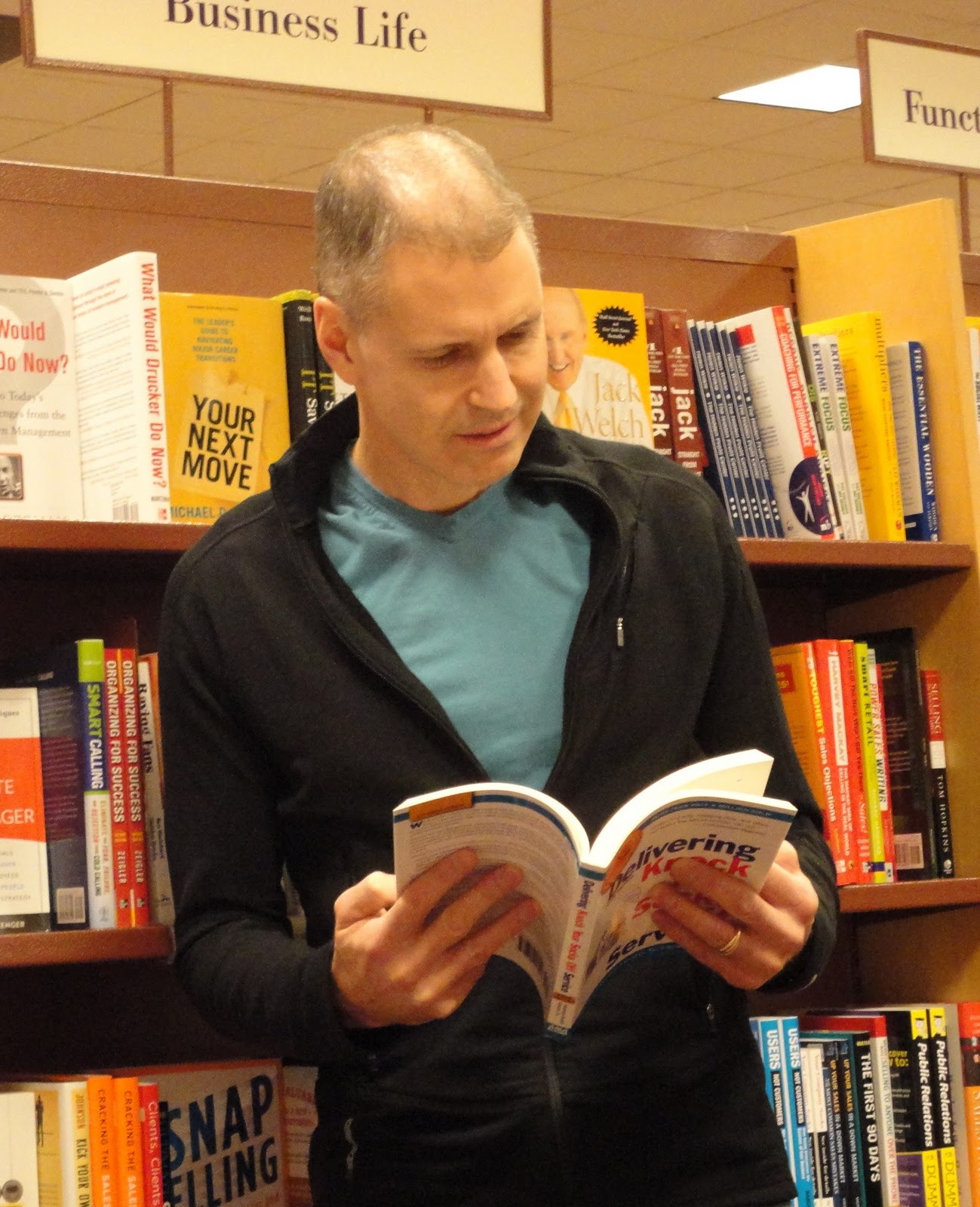
A couple of my reviewers suggested I go to a bookstore to see how other books in my genre are formatted, so I went on assignment. I flipped through books in the business and self-help sections. I felt like Goldilocks before she tried the third bed: some were too academic, some were too playful, and none were 'just right.'


Traditional layouts included blocks of text that were hard to scan - they looked like work. Highly illustrated books were fun but difficult to navigate. What struck me was that a book was either easy or hard to navigate - there was no middle ground.
Phil, looking inconspicuous 
Here are guidelines that will help me select an effective layout:


- Titles need to stand out - they are the key navigation markers
- White space is good - the less on a page the easier it is to navigate
- Elements need to balance - lopsided pages look wrong
- Icons are effective signposts - too many are confusing and gimmicky
- Text boxes prioritize content if used sparingly -  too many are confusing 
- Different fonts and text sizes communicate order - too many are confusing
- If pages aren't inviting and easy to digest,  they need to be simplified
Charlie's reward
...not in my genre


Now, I find myself assessing the layout of every book I pick up: Where is my eye directed to? Is there a logical order to the page? Is it easy to navigate? The biggest question, however, is 'Do I want to keep on reading?'


Phil