Showing posts with label editing. Show all posts

Friday, 7 December 2012

If it looks like a duck...

A Duck
At a meeting I facilitated last week, someone mentioned that she had referenced the 'duck test' (if it looks like a duck, swims like a duck,  and quacks like a duck, then it probably is a duck) to her team and no one knew what she meant.

I feel like I am going through the duck test now as the hard cover version of my book is being assembled. I asked my Wiley production supervisor if she could send me a sample of the layout design and she kindly sent me a few pages. 


Fonts: Blumner MTStd, Minion Pro 
and Ocean Sans
Here's where the duck test comes in. The layout looks like a hard cover business book, the fonts are similar to other hard cover business books, and the dimensions are common to most hard cover business book. Therefore, Change with Confidence will look and feel like a hard cover business book. I am getting more and more excited as I see the physical elements come together. Each one is a 'pinch myself' moment, a small win that needs to be celebrated. Celebration is an important factor of successful change management and I am seeing my motivation spike every time I have one.

Two observations came to mind when studying the layout: It will be easy to flip through my book to find specific information, which has always been a must-have requirement. Also, the templated examples are shown exactly as they were created during big change projects, which reflects the experience-based, practical nature of my book. 

 The cover is the final element of the design phase. As long as it looks like a business book (the duck) then my book will be in good shape.

Phil

Friday, 30 November 2012

What's on the Cutting Room Floor?


I was excited to see my edited manuscript in my inbox, which kicked off the next step on my path - making publisher edits. My editor said there were no  major changes, which was a relief, but how many edits would there be? There were 152, which isn't that many for a 257 page (52,000 word) book. Or is it?
I felt like a kid getting back a test. Did I pass? I decided to jump in and read through the changes before making the edits. My first impression was that the edit comments were really well written. It makes sense that publishing professionals would be excellent writers but I kept saying, "that's a really good way of explaining the point. This is really well written." Here is a breakdown of edits:

  • Clarification of meaning                 52
  • Reword/word substitution              31
  • Quote source                                 22
  • Formatting                                     13
  • Request to add text                       10
  • Confirm spelling of name               12
  • Define term                                      6
  • Bullet point order                             5
  • Compliment  to the author               1


I was asked to comment on each edit and make changes using Microsoft Word's "track changes" feature. I usually find this way of editing a file to be messy but this was a high-end version which worked really well. There were only five edits I did't make because they would have changed my intended meaning. That seems like a small number and is a sign of amazing editors. 

It took twenty hours to make the changes and by the end of the process I felt I had a personal connection with my editors. The final editing phase was a good one: I had a better manuscript and had learned a few tips on writing. It doesn't matter what's on the cutting room floor. What's left on the table is what counts.

Phil

Friday, 13 July 2012

If a picture is worth a 1,000 words, what about a video?

It makes sense that a consumer needs to be interested in a product before buying it. No interest, no sale. My challenge is to inspire interest in publishers to review my book proposal. No interest, no review, no sale.  


One barrier to interest is the commitment of time to read it before knowing whether or not it is worth reading. To overcome this challenge, I am creating a short video to introduce my book,  describe what it contains, and outline the benefits of reading it. 


Fortunately, Mel, my good friend and colleague,  is an excellent video director and editor. We spent Thursday morning filming (twenty-nine takes!) and selecting footage. Before shooting, the agenda was:

  • What is my book about?
  • Why buy my book (benefits)?
  • What are my credentials?
  • How is it unique?
  • What is the audience?
  • Call to action: read my book proposal

After many takes, the agenda was reduced to:

  • What is my book about?
  • What are my credentials?
  • Why buy my book (benefits)?

The more I talked on camera the less clear my message became. I wanted to explain my points in detail, which was counter to my objective. To be interesting, a good teaser video needs to be short, simple, and clear.


The footage is now in Mel's capable hands to edit and add section titles. I know she will make it look as good as it can be. The test will be how many publishers double-click on my proposal. The objective is always the bottom line.


Phil

Friday, 24 February 2012

How good is good enough?


I am writing this post after an inspiring conversation with Ken, my editor. We both had worked into the morning hours finishing our respective homework before our 10 a.m. Starbucks meeting.


Around 3 a.m., I paused for a few minutes wondering how we would know when my book is finished. How good is good enough? From my experience, when you think something is finished you still have a way to go; there is always something to change to make it better.


I remember a story about the making of Michael Jackson's Thriller. After he and Quincy Jones recorded the songs, they listened to the entire album and cut the three songs they liked the least. Michael wrote three new ones including the number one single 'Beat It.' I have borrowed this approach to upgrade the stories in my book. How did they know three was the right number of songs to replace before the album was finished? 


I will keep editing until the edits are less valuable than what they are replacing. At that point, quality will speak for itself and good will turn into great. Great is good enough. 


Phil

Friday, 17 February 2012

Be Careful What You Wish For

When I was 11 years old, I watched a TV show called Make a Wish.  I recall it being the only program on Sunday mornings that was made for kids. Each show profiled a different topic such as an animal, an invention, or an occupation. Tom Chapin (brother of musician Harry) was the host who narrated film clips and sang songs about that week's topic. Make a Wish opened with Tom singing the title song that had empowering lyrics about pursuing your dreams. I think I liked the song more than the show and often sang the first few lines of the title song:


"Make a wish, have a ball, dream a dream, be it all, 
If you want it, you can get it, but to get it, you've got to want it,
Anything you want to try, just let go, fly high,
Make a wish."  


Make a Wish came to mind when I caught myself wishing for my detailed editing work to be over. It's been a long haul and day and night editing loses its novelty over many weeks. I immediately caught myself because the experience of writing is part of my "wish," where learning a new craft and articulating my beliefs on change management are as important as the completed book. The old adage, "be careful what you wish for because it might come true," is good council for most aspects of life, including this one. Wishing that a part of an incredible lifetime experience is over is missing the point. I am "having a ball" and "being it all," so I must remember that it's all good.


Phil

Friday, 3 February 2012

Back in the Saddle Again

Self Portrait
Recently, I took on a consulting assignment to co-design and facilitate a two-day team meeting. Why did I do it? First, I had worked with the leader before and knew it would be fun.  Second, it's been a while since I worked on a change project and I didn't want to become rusty. Third, based on an initial phone briefing I knew I could help.


Getting dressed for my first meeting I remembered that tying ties is not a strength. Wearing a suit, however, felt good. As I entered the office building I felt 'corporate.' As I waited in the lobby I mused that these spaces are the same around the world - the seating area layout,  employees briskly walking with purpose, a courier dropping off a package, and a receptionist directing a call - I could have been in any city.  In the meeting, I could feel energy. There was a puzzle that needed solving and we were gathering pieces to do so. As I drove home, my mind was full of questions, facts, and possibilities. I was alive.


There is a unique confidence felt when doing something you have done successfully many times before: you know the raw materials, you can sense what works and what doesn't, and you don't stop until you get it right. This is how I felt when I was working on the design. Facilitating was great, too. Interacting with a team reminded me how much people have to give. 


Setting Up
After the event I made the following notes:

- Everything effects mood, e.g., location, tone, pacing, language, etc.
- People can't absorb all the information they are given (no matter how you give it to them)
- Individuals need to be understood and validated (including me)
- Energy is contagious
- A team with a common goal is extremely powerful
- Change work is exhausting 
- Helping people build a better future is the biggest thrill 

Now it's back to editing my second draft and writing additional stories. I have missed my book over the past couple of days. Would I take on another assignment? Absolutely, if it had the same elements as this one. You always get more than you give.


Phil

Friday, 27 January 2012

Did I tell you about the time I caught the Dali Lama as he stumbled on a plane?

I realized last week that the book I set out to write is not exactly going to be the book I will complete. And thank goodness for that. My first draft was focused on getting the content right and organizing it in a way that readers could easily navigate. I was determined to capture every lesson learned and successful approach tried so whatever a change leader could face would be addressed. 


My editor, Ken, says there's the book you intend to write and the book that it could be. The book I had written was technically sound but wasn't very interesting to read. Why couldn't my book do both? My first step is to include amusing stories that happened while being on change assignments. The ones I love to tell and people enjoy. Change is about people and not including the lighter side of being on change projects is a miss. Friends have suggested this from day-one, and so has Ken, but not until now have I understood the importance of doing so. 


I see these stories (and pictures) being displayed in sidebar boxes. Not too many; just enough to make it interesting. I am excited about the possibilities. I may even be writing a book I would be interested in reading. So, did I tell you about the time I caught the Dali Lama as he stumbled on a plane? 


Phil

Friday, 20 January 2012

What does your wallet say about you?

I told my son Sam that I was late writing this week's post, and I had to stay up late to do it. He replied, "If you weren't you, would you read your blog?" My first response was, "The personal ones, where I show a part of me." Then I added, "Since I'm into change management, I would read all of them but only enjoy the personal ones." Sam gave me a look that only a teenager can give: "Are you crazy?" or "What are you doing?" - more like "Are you crazy?" I decided to change my topic to something more interesting. 


It was very cold on Sunday (-13 C/8.6 F) when I reluctantly headed out for a 20 mile run. The thought of running for 3.5 hours outside was not "interesting." Once I got started my mood improved and it was fun waving at the sprinkling of fellow frozen runners along Lake Ontario. 


As I passed the half-way mark  my mind wandered. I thought wouldn't it be great to find a wallet on the trail. Four minutes later, right before my eyes, was a huge wallet on the path. I couldn't believe it. I picked it up and opened it. Everything looked in place: credit cards and I.D. were in their side slots, money and receipts were in the back compartment, and a picture of a loved one was behind the protective plastic cover. I looked around, saw no one, and put it in my pocket. 


As I ran home I wondered who had lost it, how he had lost it, and what he was doing now? "Was there any foul play?" my over-active mind wondered. Once home I looked through the contents to find a phone number or email address by which I could contact him. I found an address but no other information. His number was not listed so I was stuck. Taking a closer look I found a yacht club membership. I called the club and eventually they got in touch with him. 


That evening he came to our home to retrieve his wallet. We talked for a few minutes, which told me more about him than his wallet. Later on, I looked through my wallet and realized it was similar to his (except for the yacht club membership). It could have been anyone's wallet.


This theme of identity and personal expression has been raised about my writing. My readers and editor have counselled that I need to create more of a personal narrative so that my book will be more reflective of me and be more interesting. I am now making edits. You never know where you will find inspiration - even a wallet or a perceptive question from my interesting son.


Phil

Wednesday, 21 December 2011

Like a Light Bulb

The weeks that fly by are also the ones that spark the most vibrant memories. I had one of those last week. I was driving hard against an aggressive deadline, but falling behind my plan. There are two options when this happens: cut corners or cut sleep. I chose the latter. I wouldn't have felt right handing over my draft without cleaning up  my sections. It's like leaving home with coffee stains on your shirt - it's something you just don't do.


Seeing the print out of my manuscript for the first time was emotional. Flipping through the 252 double-spaced pages felt like I was holding a real book. I could sense the day when this will be true. The owners of our local UPS Store were friendly and supportive. They even gladly took my picture in their store.


The highlight of my week, however, was meeting my editor, Ken. We spoke for over two hours about my book. He observed that I talked about what I wanted my book to be. Ken wisely pointed out that he might be able to help me discover what it could be. What a riveting conversation we had. I was beaming as I shared a few of my stories and he shared a few of his views on book-making. I am excited by our partnership and look  forward to reading his notes in January.


But now it's the holidays, a time for family and friends. It's also time to catch up on my reading. It will be good to focus on what others have to say.


Phil

Thursday, 15 December 2011

The 14 days of Changes

I had an exhilarating call with a professional editor whom I met through a friend. He was personable, fun and knowledgeable. We discussed my book and how a reader might use it. He shared his first perceptions and briefed me on the publishing world. My favourite observation was that fifty-five questions (chapters) may be too many. But they are all important, I thought. I also thought, I think I need a professional editor! 


Time flew by, as it usually does when absorbed in conversation. By the end of the call a partnership was formed. I would handover my draft manuscript on December 21st and he would edit it over the next couple of weeks. 


After hanging up the phone, I created a mindmap drawing of what I needed to do before the 21st.The page quickly became full. I needed to reformat quotes, rewrite the introduction, and write a 'how to use this book' section, an 'afterword,' and six more stories. I also had to inject more 'Phil' into the writing style - all in fourteen days. 


Given the messiness of my drawing, and with a nod to the holiday season, I created an Advent Calendar to share my work schedule. I have five more days and nights to go and am on track. The good news is I'll have three days to do my Christmas shopping after my draft is complete!  Phil

Sunday, 4 December 2011

On Assignment: Chapters Bookstore, December 5, 2011

As I make changes to my book's content and structure, I am starting to think about its layout. This element of publishing is another important one. It can either make or break a book's accessibility. This is especially true for the time-starved reader who needs advice fast.  The more I can facilitate quick access to relevant information, the better. 


Charlie, my accomplice
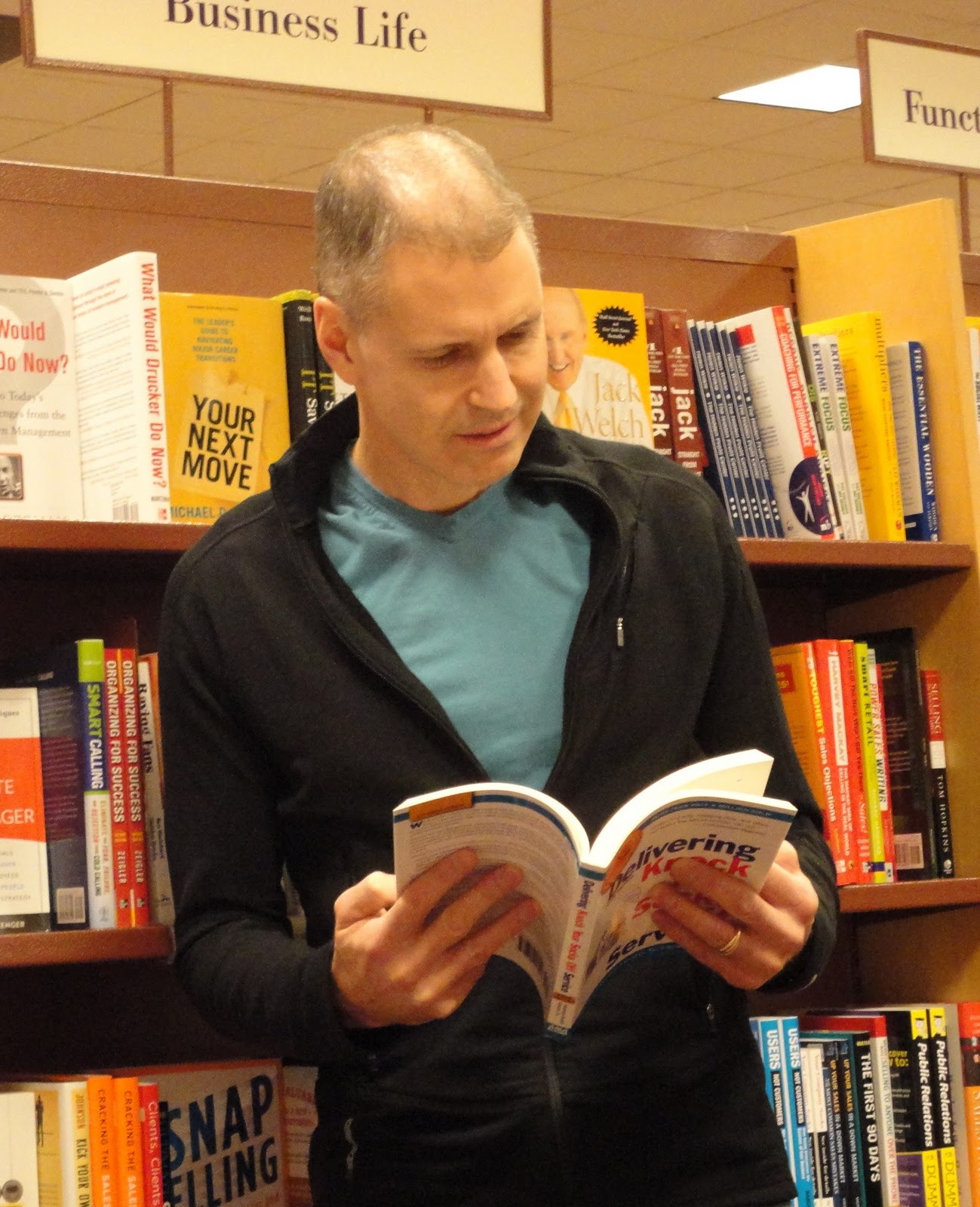
A couple of my reviewers suggested I go to a bookstore to see how other books in my genre are formatted, so I went on assignment. I flipped through books in the business and self-help sections. I felt like Goldilocks before she tried the third bed: some were too academic, some were too playful, and none were 'just right.'


Traditional layouts included blocks of text that were hard to scan - they looked like work. Highly illustrated books were fun but difficult to navigate. What struck me was that a book was either easy or hard to navigate - there was no middle ground.
Phil, looking inconspicuous 
Here are guidelines that will help me select an effective layout:


- Titles need to stand out - they are the key navigation markers
- White space is good - the less on a page the easier it is to navigate
- Elements need to balance - lopsided pages look wrong
- Icons are effective signposts - too many are confusing and gimmicky
- Text boxes prioritize content if used sparingly -  too many are confusing 
- Different fonts and text sizes communicate order - too many are confusing
- If pages aren't inviting and easy to digest,  they need to be simplified
Charlie's reward
...not in my genre


Now, I find myself assessing the layout of every book I pick up: Where is my eye directed to? Is there a logical order to the page? Is it easy to navigate? The biggest question, however, is 'Do I want to keep on reading?'


Phil 


Sunday, 27 November 2011

Looking at the Stars and Finding the Constellations

This week was very productive. I spent it absorbing feedback I received from my reviewers. An author friend cautioned that reading feedback "...is both exhilarating (because you are making the final product that much better) and frustrating, especially when reviewers offer contradictory advice." I found it exhilarating and exhausting, but not frustrating. There were more common themes than individual threads. 
                                                                                                                                                                  
The great news is that I am on track to completing the book I wanted to write. Equally great news - there are many ways I can make it better and I still have a lot of work to do.

Reviewing multi-source feedback feels like the role Tom Cruise played in Minority Report; your job is to look for patterns across multiple pieces of information. The challenge is to keep everything in your head while you find the connections. I wonder if Tom got headaches while he was filming these scenes.


Speaking with my reviewers to clarify points and test solutions has been a great help.  Halfway through these discussions, here are the changes I am making:
  • Audience: clarify who the book is written for
  • Navigation: be more directive on how best to use the book
  • Structure: categorize chapters by theme - results, the plan, resources, and communication
  • Format: add graphic elements to help the reader find the information they need
  • Content: open each chapter with one or two quotes and remove the 'Words of Wisdom' section
  • Content: Delete the stories that don't illustrate 'What works/What doesn't work' sections
  • Writing Style: Make it more personal, more 'Phil' - some parts read like a text book

Reviewing feedback is like searching for constellations. The stars are in full view, but you need to look hard to find the patterns. Having a team of generous astronomers helps a lot.

Phil

Wednesday, 16 November 2011

How to Unwrap a Gift So You Fully Appreciate It


The other day, I was scrolling through a technical newsletter (to improve my social media strategy!) and I came across an intriguing article called 'Unboxing the Kindle Fire.' A lot has been written about this low cost, high value tablet but this was the first article I had seen about how to properly unveil one. Since feedback is like a gift, this was an apt analogy for opening my reviewers' comments on the sample excerpt they have read.

Like most things in life, there are bad, good and best ways of doing them. I reasoned it would be wise to put some thought into how best to open my feedback to make the most of the experience. 


Here are the guidelines I follow:


- Open one gift at a time
- Unwrap it slowly
- Look at the whole gift first and then look at 
the details 
- Appreciate why the giver chose the features - they were selected  for a purpose
- Keep the packaging - care was put into the wrapping, which is an important part of the gift
- Enjoy the experience
- Be grateful


To push the analogy further, I will line up my gifts and look for trends. Are there common themes? Any types of gift I haven't received? What is the best order in which to explore them?


It is better to give than to receive, but receiving is great, too!


Phil

Thursday, 10 November 2011

All feedback is good, but could you include these things?


As I was preparing my book excerpt to be reviewed by a few peers, I realized I needed to give guidance on the feedback I wanted to receive. All feedback is good, however, I don't want to miss certain aspects.


Overall, I'm looking for feedback from a reader's perspective versus a content expert's. The content is built from my experiences of 'making change,' so I expect others will have different experiences and views - no issue. What is far more helpful is feedback on how people take in the book. Specifically, its utility and style: "Is it valuable?" and "Is it interesting?" I am also looking for feedback on how the book is constructed. Finally, I'm curious about what I should call the creation. What title will speak to the reader when looking for a practical change management book? 


Here are the questions I included with my book excerpt:


Introduction
  • Does it effectively convey the reader's challenge?
  • Does it effectively outline the format of the book?
  • Does it make you want to read on?
Table of Contents (each question  is a chapter)
  • Does the order of the questions look right?
  • Have I missed any essential questions? If so, which ones?
  • Too much, too little, just right?
Six sample Questions
  • How useful is the information?
  • Is the style engaging, boring, etc.?
  • Does the format help or hinder the time-starved reader in finding the information needed?
Possible Title Options
  • Rank order the top three options, including any you can suggest
  • How much do you like your top choice?
Possible Sub-title/Tag Line Options
  • Rank order the top three options, including any you can suggest
  • How much do you like your top choice?


You may be thinking what I am thinking: I am hugely indebted to my feedback providers for taking the time to review my material and give me this feedback. I will appreciate every comment. 

Hmmm, maybe I should have asked one more question: "What do you think about the number of feedback questions - too much, too little, just right?

Phil

Friday, 4 November 2011

I've Never Met A Deadline I Didn't Like


I've been focusing on editing the first draft of my book. It's detailed, painstaking work that can't be rushed. I tried rushing at one point, and like the novice speed reader, accomplished the task and achieved little. 


I resigned myself to putting in the hours and slowly made progress. However, no matter how optimistic I am, finishing 8 questions out of 55 still left 43 questions unfinished at the end of last week.  I told a friend that I was getting concerned about the time it would take until I could send an excerpt of my book to some esteemed colleagues for feedback (my next step). He pointed out that since I was only sending the introduction and 6 sample questions, I could send it off before editing the rest.  Why didn't I think of that?


The clouds parted and I could see sunlight. I had a short-term goal and all I needed was a deadline. Due dates that are close enough to touch always have been the most motivating for me, so I picked the following Friday -- today!


I am not like Douglas Adams who said, "I love deadlines. I like the whooshing sound as they fly by." I take them seriously and tap into them for energy. They put me into action mode and drive me to make a plan based on the resources and time available. They also keep me focused on the most important activities.


Once I had set my deadline I accomplished the following:
  • Broke down the work into a plan
  • Defined the feedback I was looking for - reader versus editor based
  • Created a prototype review package including instructions, content and feedback questions
  • Selected the six questions for review that are representative of the entire book
  • Tested the logic of my selections with a friend and advisor
  • Edited the introduction and sample questions
  • Chewed many packs of Trident gum

By Wednesday night, time was running out. Editing was taking as long as usual and one of my questions needed to be rewritten. I stayed up until 2am to get back on track, which felt both tiring and invigorating. At 10pm on Thursday night, I completed my package. After a quick review with the same friend this morning, I'll send it out to the people who have generously agreed to read my work. 

It will feel good once the last package has been sent. Then it's back to the 43 remaining unedited questions. Time to select a new deadline.

Phil