Phil
Showing posts with label receiving feedback. Show all posts
Friday, 27 January 2012
Did I tell you about the time I caught the Dali Lama as he stumbled on a plane?
Phil
Sunday, 4 December 2011
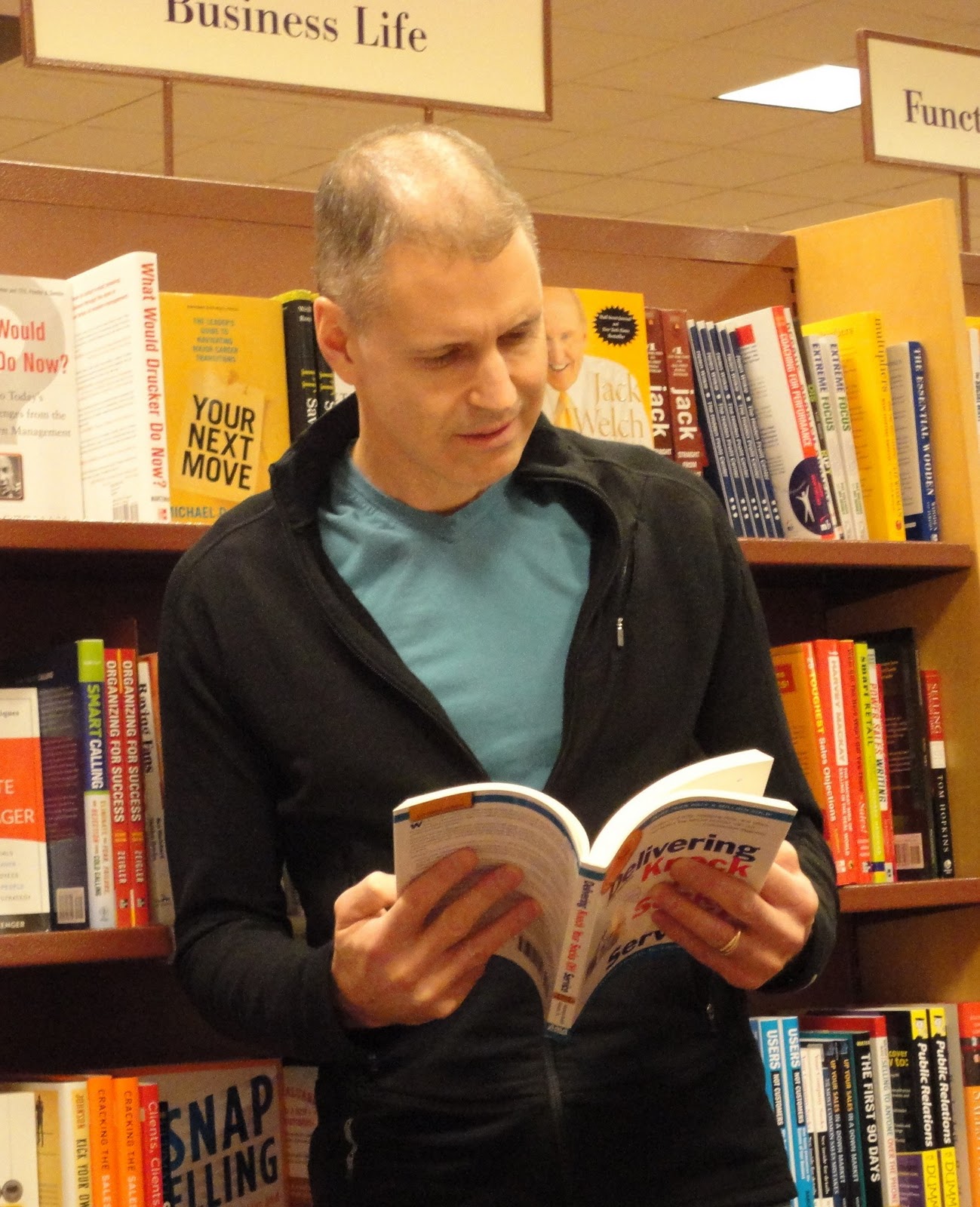
On Assignment: Chapters Bookstore, December 5, 2011
As I make changes to my book's content and structure, I am starting to think about its layout. This element of publishing is another important one. It can either make or break a book's accessibility. This is especially true for the time-starved reader who needs advice fast. The more I can facilitate quick access to relevant information, the better.
A couple of my reviewers suggested I go to a bookstore to see how other books in my genre are formatted, so I went on assignment. I flipped through books in the business and self-help sections. I felt like Goldilocks before she tried the third bed: some were too academic, some were too playful, and none were 'just right.'
Traditional layouts included blocks of text that were hard to scan - they looked like work. Highly illustrated books were fun but difficult to navigate. What struck me was that a book was either easy or hard to navigate - there was no middle ground.
Here are guidelines that will help me select an effective layout:
- Titles need to stand out - they are the key navigation markers
- White space is good - the less on a page the easier it is to navigate
- Elements need to balance - lopsided pages look wrong
- Icons are effective signposts - too many are confusing and gimmicky
- Text boxes prioritize content if used sparingly - too many are confusing
- Different fonts and text sizes communicate order - too many are confusing
- If pages aren't inviting and easy to digest, they need to be simplified
Now, I find myself assessing the layout of every book I pick up: Where is my eye directed to? Is there a logical order to the page? Is it easy to navigate? The biggest question, however, is 'Do I want to keep on reading?'
Phil
| Charlie, my accomplice |
Traditional layouts included blocks of text that were hard to scan - they looked like work. Highly illustrated books were fun but difficult to navigate. What struck me was that a book was either easy or hard to navigate - there was no middle ground.
| Phil, looking inconspicuous |
- Titles need to stand out - they are the key navigation markers
- White space is good - the less on a page the easier it is to navigate
- Elements need to balance - lopsided pages look wrong
- Icons are effective signposts - too many are confusing and gimmicky
- Text boxes prioritize content if used sparingly - too many are confusing
- Different fonts and text sizes communicate order - too many are confusing
- If pages aren't inviting and easy to digest, they need to be simplified
![]() |
| Charlie's reward ...not in my genre |
Now, I find myself assessing the layout of every book I pick up: Where is my eye directed to? Is there a logical order to the page? Is it easy to navigate? The biggest question, however, is 'Do I want to keep on reading?'
Phil
Sunday, 27 November 2011
Looking at the Stars and Finding the Constellations
The great news is that I am on track to completing the book I wanted to write. Equally great news - there are many ways I can make it better and I still have a lot of work to do.
Reviewing multi-source feedback feels like the role Tom Cruise played in Minority Report; your job is to look for patterns across multiple pieces of information. The challenge is to keep everything in your head while you find the connections. I wonder if Tom got headaches while he was filming these scenes.Speaking with my reviewers to clarify points and test solutions has been a great help. Halfway through these discussions, here are the changes I am making:
- Audience: clarify who the book is written for
- Navigation: be more directive on how best to use the book
- Structure: categorize chapters by theme - results, the plan, resources, and communication
- Format: add graphic elements to help the reader find the information they need
- Content: open each chapter with one or two quotes and remove the 'Words of Wisdom' section
- Content: Delete the stories that don't illustrate 'What works/What doesn't work' sections
- Writing Style: Make it more personal, more 'Phil' - some parts read like a text book

Reviewing feedback is like searching for constellations. The stars are in full view, but you need to look hard to find the patterns. Having a team of generous astronomers helps a lot.
Phil
Wednesday, 16 November 2011
How to Unwrap a Gift So You Fully Appreciate It

The other day, I was scrolling through a technical newsletter (to improve my social media strategy!) and I came across an intriguing article called 'Unboxing the Kindle Fire.' A lot has been written about this low cost, high value tablet but this was the first article I had seen about how to properly unveil one. Since feedback is like a gift, this was an apt analogy for opening my reviewers' comments on the sample excerpt they have read.Like most things in life, there are bad, good and best ways of doing them. I reasoned it would be wise to put some thought into how best to open my feedback to make the most of the experience.

Here are the guidelines I follow:
- Open one gift at a time
- Unwrap it slowly
- Look at the whole gift first and then look at
the details
- Appreciate why the giver chose the features - they were selected for a purpose
- Keep the packaging - care was put into the wrapping, which is an important part of the gift
- Enjoy the experience
- Be grateful
To push the analogy further, I will line up my gifts and look for trends. Are there common themes? Any types of gift I haven't received? What is the best order in which to explore them?
It is better to give than to receive, but receiving is great, too!
Phil
- Unwrap it slowly
- Look at the whole gift first and then look at
the details
- Appreciate why the giver chose the features - they were selected for a purpose
- Keep the packaging - care was put into the wrapping, which is an important part of the gift
- Enjoy the experience
- Be grateful
To push the analogy further, I will line up my gifts and look for trends. Are there common themes? Any types of gift I haven't received? What is the best order in which to explore them?
It is better to give than to receive, but receiving is great, too!Phil
Subscribe to:
Posts (Atom)